ai
AI Won't Fix Your Broken Process. It Will Just Make It Faster.
"A while back I watched a mid-size company announce, with great fanfare, that AI was going to take their vendor onboarding process from twelve weeks to four."
A while back I watched a mid-size company announce, with great fanfare, that AI was going to take their vendor onboarding process from twelve weeks to four.
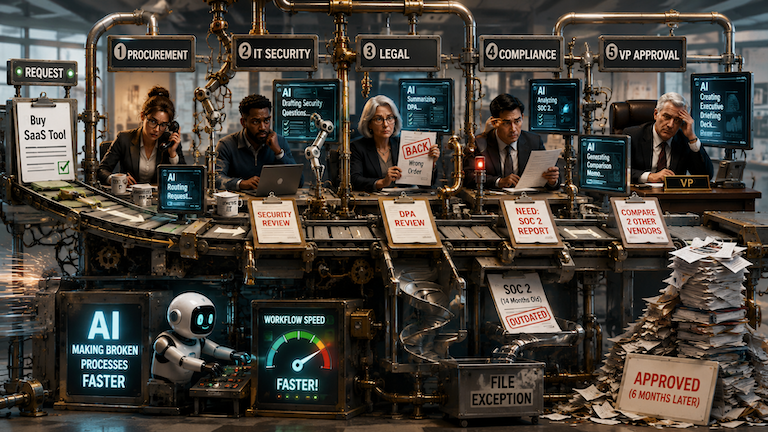
For those not familiar with vendor onboarding inside a typical enterprise, here is the short version. You want to buy a SaaS tool. You file a request. Procurement routes it to IT for a security review. IT loops in legal for the data processing agreement. Legal sends it back to procurement saying they should have been the first stop, not the third. Procurement reroutes to compliance. Compliance asks for a SOC 2 report. The vendor sends one that is fourteen months old. You file an exception. The exception requires VP sign-off, and the VP wants a comparison with two other vendors you have never heard of. Three months in, nobody can remember what problem you were trying to solve in the first place.
Six months and several million dollars of consulting later, this same company had layered AI into four different points in the workflow. AI drafted the security review questions. AI summarized the SOC 2. AI generated the vendor comparison memo. AI even produced an executive briefing deck for the VP. The average onboarding time came down from twelve weeks to eleven and a half. The VP called it a success.
That is the whole story of AI in enterprise business process right now. Nothing got fixed. Things just got marginally faster at being broken.
Adding AI to a broken process accelerates the dysfunction
There is a persistent belief, especially in boardrooms, that you can pour AI into any process flow and it will magically come out the other side as something better. The real problem is that the process flow today is not efficient because it is not well defined, and because it has too many stakeholders with overlapping responsibilities sitting on top of it.
AI does not fix any of that. AI just speeds up small parts of the flow without touching the root problem. The organization still has too many layers, the layers still overlap, and the chaos and confusion that produced the twelve-week timeline are still there. Adding AI to a broken business process does not fix the problem. It simply accelerates the dysfunction.
When the underlying workflow is chaotic, when it relies on undocumented human improvisation, when the data feeding it is incomplete or wrong, AI will magnify the errors, scale the incorrect outputs, and multiply the confusion at digital speeds. You used to send a wrong answer once a week. Congratulations, now you can send it forty times an hour, with confidence and a nicely formatted summary at the top.
The hard work nobody wants to do
So what can we do about this? The honest answer is the part nobody wants to hear, because it is unsexy, slow, and political, and it does not show up nicely on a roadmap slide.
Discover and document. Audit exactly how the process functions in reality, not how the org chart says it should function. Find the human workarounds. Find the spreadsheets people maintain on the side because the official system is unusable. Find the instant messages where the actual decisions get made. Until you have an honest map of the process as it is actually run, you are optimizing a fiction.
Standardize. Cut the waste. Eliminate the steps that exist only because somebody senior added them in 2014 for a reason nobody can remember. Collapse the duplicate approvals. Pick a single owner for each handoff. Build a version of the workflow that is consistent, repeatable, and small enough to fit in one person's head.
Redesign for AI, not around it. This is where most companies get it backwards. They ask "how can AI make this old step faster" when the better question is "is this step even necessary once AI is part of the picture." AI thrives inside defined structures with bounded scope. Give it one well-scoped job inside a clean process. Do not ask it to operate an entire messy department and then act surprised when the messy department gets messier.
The kicker
Here is the part that I find genuinely funny, in a dark sort of way. Every single one of those three steps would streamline the business process on its own, without an LLM anywhere near it. Discover, standardize, simplify. That is just operational excellence. Toyota figured this out in the 1950s. McKinsey has been billing for it for sixty years. None of it is new and none of it requires a frontier model.
The reason it does not happen is not technical. It is that the work is hard and political. Documenting how a process actually runs means telling a VP that their pet approval step is theatre. Standardizing means asking two teams with overlapping mandates which one is going to lose. Eliminating steps means firing people, or at least reassigning them, and nobody wants to be the executive who put that motion forward.
AI offered every organization a way to avoid that fight. Just buy the tool, layer it on top, and tell the board you are "AI-enabled." No politics. No reorgs. No hard conversations. And nothing actually fixed, because the AI is sitting on top of the same mess it was supposed to clear up.
Fifty years of the same lesson
Fred Brooks published The Mythical Man-Month in 1975. The headline insight, that adding people to a late and badly defined project just makes it later, is now half a century old. We have spent fifty years failing to convince executives and investors that you cannot accelerate a poorly defined process by throwing more bodies at it. Nine people still cannot make a baby in one month.
There is no point in pretending AI is the thing that finally makes the lesson stick. It will not. The people who refused to learn it when the variable was headcount are not going to learn it when the variable is tokens. They will announce a transformation, set an impossible target, fire the senior people who would have caught the problems, and act surprised when the launch slips and the output is worse than what they had before.
But wait, there is more. The same executives who cannot define a clean approval workflow are now going to ask AI to run the company. That is going to be its own series of blog posts.
The bottom line
The bottom line is this. AI is not a magic bullet for broken business processes. The work that fixes broken business processes is the same work that has fixed broken business processes for the last seventy years. Map the reality, cut the waste, standardize the flow, give clear owners and clear handoffs. Then, and only then, look at where a well-scoped AI tool can shave time off a step that genuinely needs to exist.
The organizations that win on AI over the next decade are going to be the ones that finally do the unglamorous work of fixing their processes. The ones that lose are going to be the ones that bought four AI tools, layered them on top of a twelve-week vendor onboarding process, and called eleven and a half weeks a win.
AI is not the work. AI is the reward for doing the work.
Topics: