crtc
Click to Cancel Comes to Canada (And I Have Some Thanking to Do)
"Back in November of 2025, I wrote a post called "Click to Cancel: Why Canada Needs to Catch Up" (https://mgamble.ca/p/click-to-cancel-why-canada-needs-to-catch-up)."
Back in November of 2025, I wrote a post called Click to Cancel: Why Canada Needs to Catch Up. I griped about the 20 minutes I lost cancelling a TV service through a phone tree, the nearly $500 I burned on a forgotten backup internet stick, and the FTC's refreshingly simple "click to cancel" rule that the United States had managed to pass while Canadian regulators stood still. The argument was straightforward: if a provider can authenticate me well enough to take my money online, they can authenticate me well enough to let me leave online.
On Friday, the CRTC delivered.
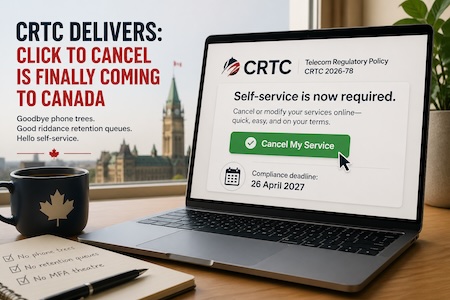
Telecom Regulatory Policy CRTC 2026-78, released 24 April 2026, finally forces every Canadian internet, wireless, home phone, and TV provider to offer a real self-service mechanism for modifying or cancelling a plan. No more retention queues. No more "let me transfer you to my supervisor." No more multi-factor authentication theatre that conveniently breaks down right when you ask to leave. The compliance deadline is 26 April 2027, and it applies to every provider in the country with no exemption carve-outs for the small guys.
So first things first: thank you, CRTC. You did the right thing here, and you did it without watering it down at the last minute the way these processes so often go.
What the Decision Actually Does
For those not familiar, here is the short version. The October 2025 amendments to the Telecommunications Act (specifically the new section 27.01) directed the CRTC to figure out what "self-service" means and then mandate it. The Commission ran a public consultation (Telecom Notice of Consultation 2024-295), reviewed the record, and landed on a definition that is genuinely useful:
Self-service includes any mechanism that is easy to use and enables a customer to perform actions in relation to their telecommunications service plan, including modifying (e.g., upgrading or downgrading) and cancelling it, without interacting with a live customer service representative, for example, through an app, a website, or by email.
A few things in that definition deserve a slow clap. The mechanism has to be easy to use. The actions have to take effect immediately, "to the greatest extent possible." Customers have to be able to modify their plan, not just cancel it. And providers must send a written confirmation (paragraph 29) so there is a paper trail when, inevitably, somebody's cancellation mysteriously fails to register.
The Commission also did something I genuinely did not expect: it prohibited any fee for accessing any type of customer service (paragraph 26). That is a meaningful win for affordability that goes well beyond the click-to-cancel scope I was asking for back in November.
The new self-service requirement applies to individual customers and to small businesses (defined as those with average monthly telecom bills under $2,500), which captures basically every SMB I have ever worked with. Larger enterprise accounts with assigned reps are exempt, which is the correct call. Nobody running a 500-line PRI through a national account team is logging into a portal to cancel.
The Concerns Were Real (And the CRTC Handled Them Sensibly)
Now to the part I want to address head-on, because the providers raised some legitimate worries during the consultation that deserve to be taken seriously rather than dismissed.
Bell, Rogers, Telus, and the rest argued (paragraph 9) that letting customers cancel through self-service could lead to unintended consequences such as accidentally losing a telephone number, and that it introduces fraud risk if a bad actor compromises an account and uses the self-serve flow to wreck somebody's service. Smaller providers asked to be exempted on the basis that building this is expensive. Accessibility groups asked for explicit requirements around screen readers, sign-language video instructions, and video relay service integration.
These are not made-up concerns. Account takeover is a real thing. Number portability is genuinely complicated under the hood, and an inadvertent cancellation can absolutely strand a phone number. People with disabilities routinely get told that "self-service" means "no service" because the design ignored them entirely.
But here is why the Commission was right to push through anyway.
On security: the same providers that suddenly discovered fraud risk when self-service cancellation was on the table have been perfectly happy to let customers self-serve all the lucrative actions for years. You can sign up online. You can upgrade a plan online. You can buy a new phone on credit, online, in two minutes, with a level of authentication that the industry apparently considers adequate when money flows toward them. Asking for a higher security bar specifically for the one action that costs the provider revenue is not a security argument, it is a retention argument wearing a security costume. The CRTC noticed this and addressed it at paragraph 12: existing privacy and authentication frameworks already apply, and providers are free to layer additional protection on top of the self-serve flow if they actually believe the threat is asymmetric.
On the small-provider exemption: the Commission's reasoning at paragraph 37 is exactly right. Carving out exemptions creates two classes of customers (those who get to self-cancel, and those who do not) and that confusion is worse than the marginal compliance cost. The definition is flexible enough that a small WISP can satisfy it with a basic web form and an email confirmation. This is not a feature that requires a six-figure platform investment.
On accessibility: the Commission punted slightly (paragraph 30) by leaning on existing accessibility law rather than enumerating new requirements. I would have liked stronger language here, but the Accessible Canada Act does cover this ground, and the encouragement at paragraph 31 not to "rely exclusively on live customer service for customers who require accommodations" is the right principle. We will see how it gets enforced.
The bottom line is that the cons are real but manageable, and the pros (consumer mobility, actual competition, the end of "sludge" as a business model) are enormous.
A Note on Process, and a Lesson for Me
One thing jumped out reading the decision: the consultation that produced this ruling opened on 22 November 2024 and ran into early 2025. I wrote my post a full year after the proceeding had already started, and I had no idea it was happening. I could have filed an intervention. I could have added one more voice to the public record arguing for exactly the rule the Commission ended up adopting. I did not, because I was not paying close enough attention to what the CRTC was actually doing.
That is on me. If you care about Canadian telecom policy, the proceedings are public, the records are searchable, and the Commission genuinely does read interventions from individuals. I am subscribing to the CRTC's notice mailing list this week (I thought I was, but I wasn't), and I would encourage anyone else who reads this blog to do the same. The next consultation that affects your phone bill is probably already open.
What Happens Next
Providers have until 26 April 2027 to comply. Expect a lot of sandbagging between now and then. Expect "self-service" portals that technically meet the definition while being obviously designed to discourage use. Expect cancellation flows that surface eight retention offers before letting you click the final button. Expect a few "system errors" at suspiciously convenient moments.
Worth noting: the CCTS is explicitly not the body administering this requirement (paragraph 35). The CRTC is enforcing it directly, which means the complaint mechanism for non-compliant self-service flows runs through the Commission. That is a process the public is going to have to learn how to use, and I will write a follow-up closer to the deadline walking through how to file one.
Until then: Bell, Rogers, Telus, Quebecor, SaskTel, Eastlink, Cogeco, and every reseller riding on top of them, the clock is ticking. Build the right thing. The CRTC just told you what good looks like, and the rest of us are going to be checking your work.
Sometimes the regulator gets it right. This is one of those times.
Topics: