crtc
Money First, Accountability Later: Ottawa's New Internet Backbone Needs an Open Access Mandate
"He called it nation-building infrastructure and said nothing about who would own it or who would be allowed to connect to it."
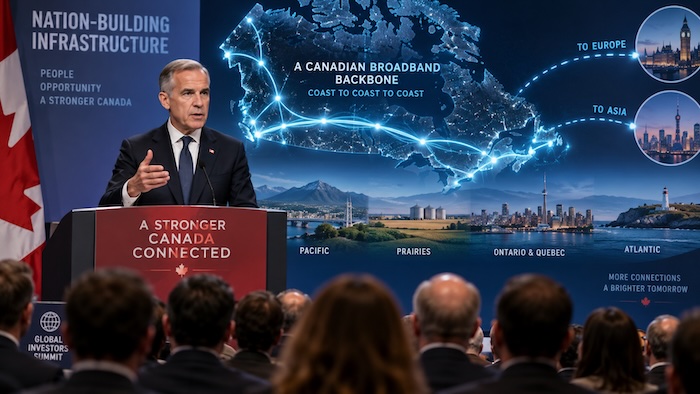
Prime Minister Mark Carney stood in front of hundreds of the world's largest investors on Tuesday and announced that Ottawa would reinvest "tens of billions of dollars" of capital into a new sovereign broadband backbone, connecting Canada coast to coast to coast with more direct links to Europe and Asia. He called it nation-building infrastructure and said nothing about who would own it or who would be allowed to connect to it. Money first, accountability later: that's the whole announcement, and Canadians who've followed telecom policy for more than a single news cycle have sat through this pattern before.
I wrote about the last instalment of this pattern two years ago, when the CRTC released decision 2023-358 on temporary fibre-to-premises access. It read like a win for independent ISPs: a new wholesale rate, finally, to resell fibre against Bell, Telus, and Rogers. Run the math and the win evaporates. The rate landed at $68.94 a month in Ontario and Quebec, but installation, transport, and operations pushed an independent provider's real costs to $90 or $110, forcing retail prices of $115 to $140 just to break even. Bell's own flanker brand, Distributel, ran promotions under $80 at the same time. The number of Canadians buying from independent wholesale competitors had already dropped 40 percent before that decision even landed, and nothing in the fine print slowed it down.
That pattern has repeated on a schedule for fifteen years now. The CRTC cut wholesale rates in 2019, reversed itself in 2023 under incumbent pressure, and upheld that reversal again in 2025, with the commission still finalizing wholesale fibre rates as recently as this spring. Roughly half of the independent providers still using the regime are now owned by the incumbents it was supposed to constrain, according to the Canadian Anti-Monopoly Project's history of the file. Michael Geist has documented the ritual that accompanies every round: Bell and Rogers warned that wholesale access would gut their capital spending in 2015, 2019, 2020, and 2023, and the threat never once materialized. It's the same playbook, run four times, without a single real consequence for running it.
So when the federal government announces tens of billions in new infrastructure spending without saying who gets to connect to it, the natural response is a question: who is this backbone actually for?
The sovereignty case behind the announcement deserves to be taken seriously on its own terms. Researchers at the University of Toronto and York University studied the path Canadian data actually takes between two domestic points and found that roughly a quarter of those journeys routed through American internet exchanges, exposing that traffic to the U.S. National Security Agency along the way. That's a legitimate national security concern grounded in actual measurement, and a domestic backbone with direct routes to Europe and Asia is a defensible response to it. The open question is whether rerouting that traffic through Canadian infrastructure actually removes the chokepoint, or simply moves it from an American gatekeeper to a Canadian one.
What does genuinely open infrastructure look like in Canada today, and where does it already exist? Independent ISPs and enterprise networks don't reach the rest of the internet by buying a single pipe from a single carrier. They peer at internet exchange points, facilities like TorIX in Toronto or YYCIX in Calgary, where dozens of networks meet in one room and hand traffic to each other directly instead of paying an incumbent's transit toll for every packet that crosses a boundary. That model works because the exchange itself stays neutral. Nobody peering at TorIX needs Bell's permission to reach a Telus customer, and that's about as close as Canadian telecom infrastructure gets to genuinely open access, sitting almost entirely outside the CRTC's wholesale regime.
The neutral-interconnection principle that makes TorIX and YYCIX work is worth building into the backbone from the start: open points of presence that any carrier, enterprise, or cloud and content-delivery network can join on published, non-discriminatory terms. Leave that principle out, and the only entities with real access to the new capacity end up being Bell, Telus, and Rogers, which turns a genuinely novel asset into a more expensive version of the network Canadians already have, just financed this time with public-backed capital instead of shareholder equity.
Australia already ran a version of this experiment and settled the ownership question by statute before construction began in earnest. NBN Co, the entity built to run that country's national broadband network, is barred by the National Broadband Network Companies Act 2011 from selling retail service at all. It exists to sell wholesale access, on the same terms, to every retail provider that wants to buy it, and that structure has survived multiple changes of government precisely because it was written into the founding legislation rather than left to a regulator to sort out later. New Zealand took a similar approach with its Ultra-Fast Broadband build, splitting network ownership from retail service from the outset.
That's the fork sitting in front of Ottawa right now, whether anyone at the investment summit said so out loud or not, and the difference between the two paths is whether open access gets written into the legislation that creates this backbone, with the same wholesale-only discipline Australia used, before a shovel goes into the ground. Skip that step and leave it to some future CRTC proceeding, and Canadians should pencil in roughly 2029 for the next instalment of this series, watching the same fifteen-year fight restart on a network we all just finished paying for.
Carney hasn't tabled legislation yet, which means there's still a window to shape what's in it. Call or write your MP and ask one specific question: will the bill creating this backbone include a wholesale-only or open-access mandate, or is that detail being left for a future CRTC proceeding to fight out? Read the bill yourself once it lands instead of taking Ottawa's press release at its word, and if the open-access mandate isn't in it, say so publicly, because the incumbents will be lobbying hard for the opposite the moment the ink is dry. Fifteen years of wholesale fights have already shown what happens when Canadians leave that fight to someone else.
Topics: