innovation
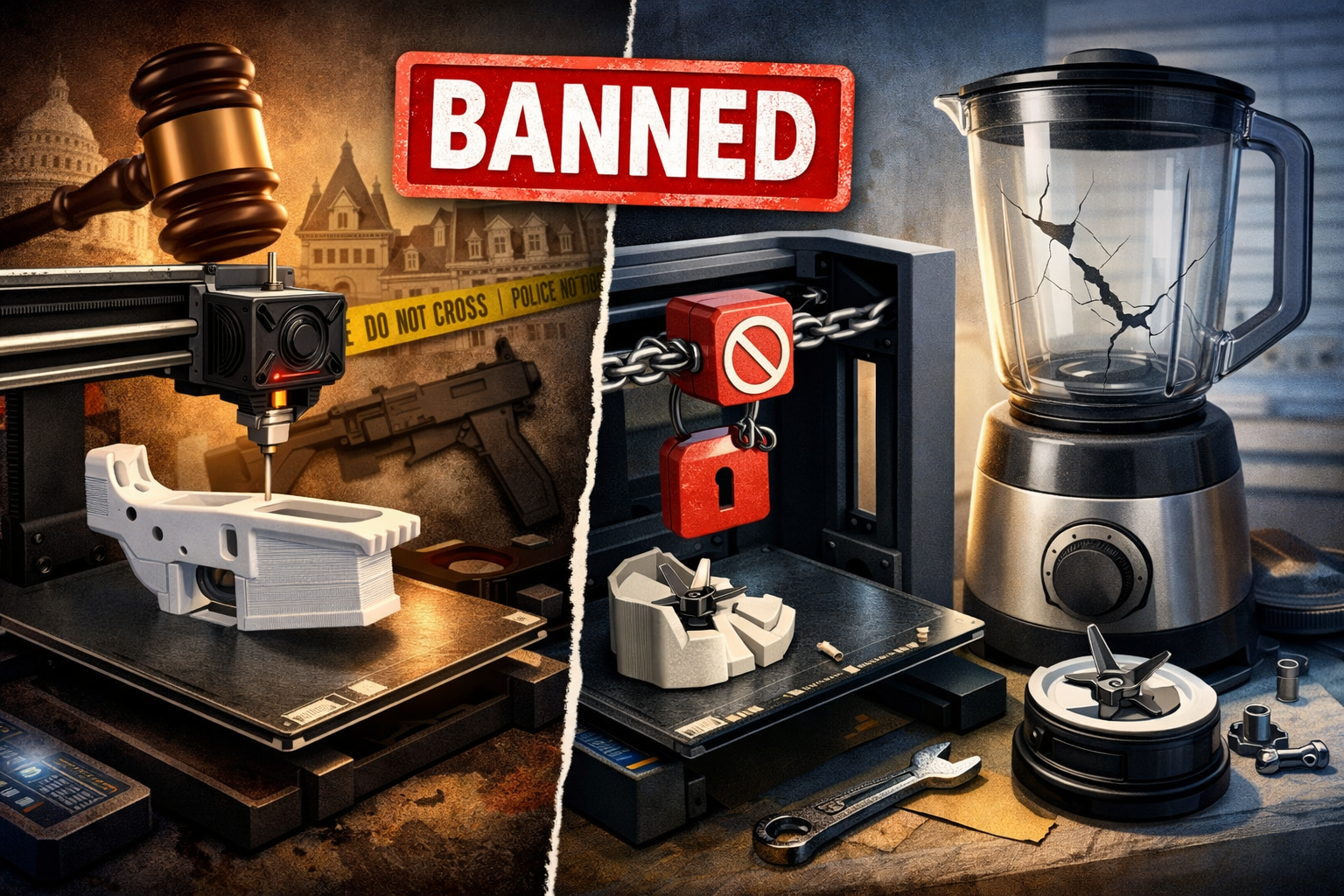
New York's 3D Printer Bill Won't Stop Ghost Guns, But It Will Stop You From Fixing Your Blender
"The problem is that it won't work, it can't work, and the real consequences will fall entirely on people who have no intention of manufacturing weapons."
New York is considering a budget bill (S.9005/A.10005) that would require all 3D printers sold in the state to include "blocking technology" that scans every print file through a "firearms blueprint detection algorithm" and refuses to print anything flagged as potentially weapon-related.
Sounds reasonable to some, I'm sure. The problem is that it won't work, it can't work, and the real consequences will fall entirely on people who have no intention of manufacturing weapons.
The Technical Problem Nobody Wants to Hear About
A "firearms detection algorithm" would need to identify every possible firearm component from raw geometry files while not flagging pipes, tubes, blocks, brackets, gears, and millions of other legitimate shapes. This is a classification problem with enormous false positive and false negative rates.
But let's be generous and pretend the algorithm is perfect. Here's where it falls apart:
The bill also covers CNC mills and "any machine capable of making three-dimensional modifications to an object from a digital design file using subtractive manufacturing." That's most of the equipment in any machine shop. Are we scanning G-code now? What about parametric designs generated at print time?
Worse, the bill would apply to open-source firmware like Marlin and Klipper, maintained by volunteers with no resources for compliance. It would apply to offline machines that never touch the internet. It would apply to file formats the algorithm can't parse.
The working group provision offers a feasibility escape hatch, but the working group could easily be stacked with non-experts who deliver the predetermined answer.
What This Law Actually Does
Let's be clear about what this legislation would accomplish:
For someone who wants to illegally manufacture a firearm: Nothing. Offline 3D printers are not difficult to build. There are many open-source plans available, and all the hardware can be ordered from AliExpress. More technically capable individuals can cobble them together from alternative sources if they want to avoid online purchases entirely. But here's the thing: the bar is even lower than that. You can simply buy a gun. In the United States, purchasing a firearm legally (or illegally) is considerably easier than acquiring the skills, equipment, and materials to 3D print functional firearm components. Anyone motivated enough to circumvent these restrictions has far simpler options available.
For a small manufacturer in New York: Congratulations, you now need to worry about whether your replacement parts trigger a false positive, or whether the in-person sales requirement limits you to whatever the closest retail store stocks. For educators and makerspaces: Good luck explaining to your compliance department why your 3D printing curriculum needs legal review.
For everyone else: Wait until manufacturers figure out this is a backdoor to protect OEM parts.
The Slippery Slope Nobody's Talking About
My biggest concern isn't even the stated purpose of this bill. It's what comes next.
Once you've established that 3D printers must scan files and refuse to print certain shapes, you've created infrastructure. That infrastructure can be repurposed. How long before you can't print a replacement part for something you bought because it looks too similar to an OEM component, and the manufacturer has thrown a little money at the right politician?
Think I'm being paranoid? We've watched DRM creep from music to movies to tractors. We've watched "right to repair" become a political fight because manufacturers don't want you fixing things yourself. The moment you accept that general-purpose tools should have built-in restrictions, you've opened the door.
Canada Already Has Laws That Make Sense
Here in Canada, we took a different approach. It's strictly illegal to manufacture, possess, or distribute 3D-printed firearms without a proper business licence. As of September 2024, regulations under Bill C-21 classify 3D-printed gun components as firearms, making it a serious criminal offence to print, possess, or share digital gun files. Violations can result in up to 14 years in prison.
Note what Canada did differently: we criminalized the behaviour, not the tool. We didn't require scanning software on every 3D printer. We didn't mandate that CNC mills phone home. We said "if you manufacture an illegal weapon, you go to prison" and left it at that.
It's a meaningful distinction. Canadian 3D printers work the same as they always have. Educators can teach without compliance departments getting involved. Small manufacturers aren't worried about false positives. And if someone uses these tools to break the law, they face serious consequences.
This Is Security Theatre
New York's bill follows the familiar pattern of legislation that looks good in a press release but accomplishes nothing in practice. It's the TSA of manufacturing policy: visible, intrusive, and demonstrably ineffective.
The people this law would actually affect are hobbyists, small businesses, educators, and the open-source community. The people it's supposedly targeting have a dozen easier paths to the same outcome.
For anyone in New York who cares about this, the bill is in early stages. The working group hasn't convened yet. There's time to push for amendments that tie enforcement to intentional illegal manufacture rather than possession of general-purpose tools, and to protect open-source and offline toolchains that have no realistic compliance path.
But if this passes as written, it won't stay in New York. Washington state proposed similar legislation. These things spread. And once the scanning infrastructure exists, it will be used for purposes nobody voted on.
Topics: