ai
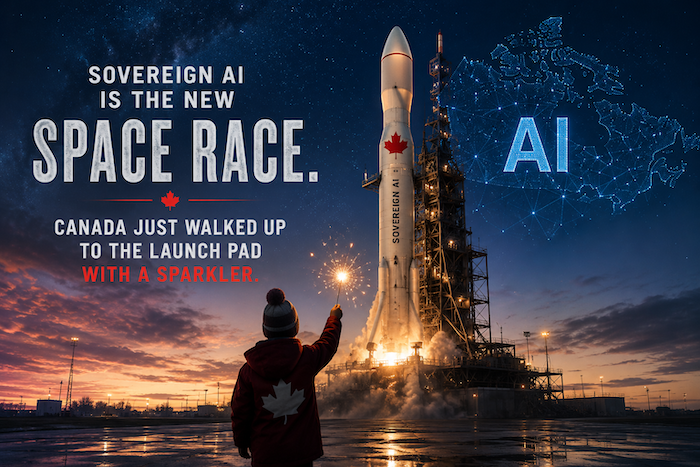
Sovereign AI is the New Space Race. Canada Just Brought a Sparkler.
"Two hundred billion dollars in economic growth."
Earlier today the Prime Minister stood up in Toronto and launched AI for All, Canada's new national AI strategy. The headline numbers are ambitious. Two hundred billion dollars in economic growth. A quarter-million new AI-related jobs over five years. AI adoption across Canadian businesses to climb from just over 12 per cent today to 60 per cent by 2034. A new public AI supercomputer. A Sovereign Technology Alliance with twelve international partners. The press release uses the words trust, opportunity, and sovereignty about a dozen times each, and I want to be fair upfront. The framing is right. Canada has been on the wrong side of the AI adoption curve for a while now, and somebody needed to actually say so from a podium.
The framing is right. The cheque attached to the framing is not.
The race is real
For those not familiar with how the next decade of computing is shaping up, "sovereign AI" is the term for a country's ability to develop, train, host, and govern AI systems on its own soil, with its own compute, on its own data, under its own rules. It is the new space race. Countries that have figured out they cannot outsource their entire AI stack to a small number of US-based hyperscalers are scrambling to build, partner, or buy their way into independence. Canada is already behind.
The Carney strategy is correct that this matters, and correct that the solution involves sovereign compute, domestic talent, smarter procurement, and international partnerships with non-US allies. The list of twelve countries Canada has signed AI cooperation agreements with since March 2025 (Australia, the EU, Finland, Germany, India, Norway, Qatar, Saudi Arabia, Spain, Sweden, the UAE, the UK) is a serious diplomatic effort and worth giving credit for. The Sovereign Technology Alliance is a real idea with real countries inside it.
So the strategic premise is sound. The execution is where I get nervous.
Let's do the math
The proposal funds the strategy at $2.4 billion over five years. That works out to roughly $480 million per year.
The federal government's total expenditure for the 2026-27 fiscal year is $594.8 billion. That makes the annual AI investment about 0.08 per cent of a single year of federal spending. Eight one-hundredths of one per cent.
To put that in some perspective, the federal Elderly Benefits program (Old Age Security and the Guaranteed Income Supplement combined) costs $88 billion in a single year. I am not making an OAS argument here. Old age security is a near-universal program for a reason and people earned it. The point is the scale. Canada will spend roughly 183 times more on senior benefits in a single year than it will spend on its entire AI sovereignty strategy across five.
This is the moment where it becomes hard to take the rhetoric seriously. You cannot, with a straight face, describe a half-billion dollars a year as the bet of a country that intends to be a serious player in a four-point-eight-trillion-dollar global market by 2033. That is the kind of number you put on a pilot project, not a national strategy. The AI Missions Program, the public supercomputer, the literacy initiative for a million post-secondary students, the AI agents for every post-secondary student, the upskilling for mid-career workers, the SME adoption support, all of it lives inside that $480 million a year. Try to make those numbers reconcile.
The Carney government is not the first government to write a big-vision press release on top of a small-vision budget, and they will not be the last. But the gap between the words space race and the actual cheque is wide enough to drive a hyperscaler through.
The question nobody answered
The strategy talks at length about job creation. Two hundred and fifty thousand new AI-related jobs. Ninety thousand work placements for young Canadians. A national literacy initiative. Upskilling for mid-career workers so they "can adapt to AI-enabled workplaces."
What it does not talk about, in any specific way, is the other side of that ledger. What happens to the workers whose jobs are not created by AI but eliminated by it.
This is the single most important question in this whole file and it gets a couple of sentences about "adapting" and "thriving." I do not think that is good enough. Every previous wave of automation, going back to the looms the Luddites set fire to, eventually generated more jobs than it destroyed. That has been the comforting story, and people are wheeling it out again. Think of all the lamp-lighter jobs that vanished when electricity arrived. Think of all the buggy whip manufacturers. We figured it out then and we will figure it out now.
I am not so sure this time.
The previous waves of automation replaced specific physical tasks with machines that still needed human operators, human maintainers, human supervisors, and human everything-else. They created new categories of work as fast as they destroyed old ones. The AI wave is different in a way that is structurally important. It is a technology being designed, explicitly, to do the cognitive work that humans currently do. The CEOs deploying it are not shy about saying so. They will use it to eliminate most or all entry-level white-collar work, and a meaningful share of mid-level work, over the next decade. A bachelor's degree, which used to be a reliable on-ramp into a stable middle-class career, is on track to be worth dramatically less.
What is the plan for the people on the wrong end of that transition? What is the plan for a society that still assigns a citizen's value based on their commercial productivity, in a world where their commercial productivity has been deliberately engineered out from under them? "We will offer upskilling" is not an answer at the scale of the problem. It is a fig leaf, and a thin one. The hardest question in AI policy is whether the gains will be shared widely enough that the displacement is bearable, and this strategy does not engage with that question at all.
The adoption gap is real, but it is not a money problem
The 12 per cent to 60 per cent adoption target by 2034 is the right kind of stretch goal and the right kind of focus on micro, small, and medium enterprises. Canadian businesses, on average, have been slow to adopt new productivity-improving technology for decades. AI is the next chapter in a long story, and we are not the chapter's heroes so far.
But the adoption gap is not really a money problem. You cannot fix it by writing a cheque. You fix it by helping small businesses understand what AI can actually do for them, by lowering the integration cost, by making sure the cloud and connectivity and data infrastructure under them is reliable and affordable, and by addressing the genuine fear among small business owners that they will spend money on AI and end up worse off. Funding is a small piece of that. Capacity and confidence are the bigger pieces. The strategy talks about both, which is good. Whether the implementation matches the talk is the question, and the implementation has not happened yet.
The "Canadian values" problem
This is the part of the announcement that I keep getting stuck on, even as the most market-friendly reader in the room.
The strategy says, in multiple places, that Canadian AI will be developed and deployed in ways that "reflect our values." Carney's own quote in the press release frames it as AI "governed by Canadian values with a clear goal of improving the lives of all Canadians." The supporting document repeatedly invokes inclusion, official languages, government values, and equity-based standards as design constraints on what Canadian AI is supposed to be.
I do not want my private use of AI, my business's use of AI, or the tools available to me, filtered through Ottawa's preferred ideological framework, whichever party happens to be writing the framework at the time. The CRTC, CRA, and ISED do not need a copy of my chat history to validate that my queries are aligned with the current federal values document. That is not a partisan concern. I would say the same thing if a Conservative government was insisting that Canadian AI reflect its version of national values.
But I want to be honest about the counter-argument, because the counter-argument is real. Every AI model on the market today has bias baked into it, including the ones being trained right now by US, Chinese, and European firms. You are choosing your bias either way. There is a serious case to be made that bias under public, accountable, Canadian governance is preferable to bias under the unaccountable proprietary control of a foreign hyperscaler. I do not love either option, but if I have to pick I would rather know exactly what the bias is, who chose it, and how to push back on it.
So I will hold this one with both hands. The values language makes me uneasy. The complete absence of values language would arguably be worse. The question is whether the actual implementation gives Canadians real choice between models with different bias profiles, or whether "Canadian AI" turns into "the one approved model with the approved guardrails." I will be watching.
The bottom line
The bottom line is this. The Carney government is correct that sovereign AI matters, correct that Canada is behind, correct that the adoption gap is real, and correct that we cannot leave the entire stack to a handful of American hyperscalers. The diagnosis is right.
The treatment is underfunded by about an order of magnitude, dodges the single most important question of the AI transition (what happens to the workers it displaces), and reaches for a "reflects our values" framing that needs a great deal more specificity before anyone should be comfortable with where it leads. A serious sovereign AI strategy looks like a fifteen-billion-dollar investment with a concrete plan for the labour-market disruption it is going to cause. This is a two-and-a-half-billion-dollar press release with a fig leaf on the hardest parts.
Sovereign AI is the new space race. Canada just walked up to the launch pad with a sparkler.
I would love to be wrong. Watch this space.
Topics: