amazon
They Used a Lost Puppy to Sell You a Surveillance Network
"I was watching the American feed of the Super Bowl last night when Ring's latest ad came on."
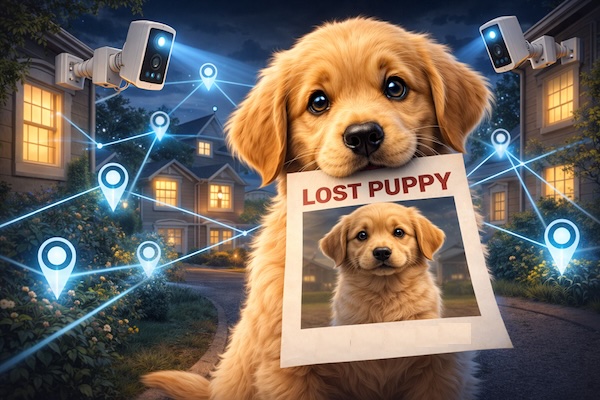
I was watching the American feed of the Super Bowl last night when Ring's latest ad came on. A family loses their dog. They upload a photo. Ring's network of neighbourhood cameras springs into action, and the puppy is found. Heartwarming music. Happy ending. Who could possibly object?
Me. I object.
Because what Ring just advertised wasn't a pet-finding service. It was the normalization of a 60-million-node surveillance network spanning North America, and they wrapped it in a golden retriever so you wouldn't notice.
The Quiet Part They Didn't Say Out Loud
When you install a Ring doorbell, you're not just getting a camera. You're giving Amazon access to a microphone and video feed inside or outside your home. That feed can be accessed by Amazon, by third parties you've never heard of, and by law enforcement, often without a warrant, without notification, and without your consent.
Amazon will tell you this only happens in "emergency situations." If you believe that, I have a bridge to sell you. We've seen how this plays out. Tesla employees were caught sharing dashcam footage internally for laughs. One couple discovered video of themselves in an intimate moment had been pulled from their vehicle's cameras and uploaded to the internet.
But surely Amazon would never let that happen with Ring. Surely the company that turned Alexa into an advertising delivery platform has your privacy as their top priority.
This Isn't About Your Doorbell. It's About Infrastructure.
Sixty million cameras. Think about that number. That's not a consumer electronics product. That's surveillance infrastructure operated by a private company with opaque data-sharing agreements and law enforcement partnerships. And it's not just Ring. FLOCK cameras, which are starting to appear in Canadian communities, are partnered with U.S. Immigration and Customs Enforcement. The same cameras municipalities are installing to "improve safety" are feeding data to agencies that use it to track and target people without judicial oversight.
Security researchers have already demonstrated they can compromise FLOCK systems. Ring has had its own security incidents. These aren't theoretical vulnerabilities. They're inevitabilities.
What Canadian Law Actually Says
Section 8 of the Charter protects Canadians against unreasonable search and seizure. Recent Supreme Court decisions, particularly R. v. Bykovets, have reinforced that privacy isn't binary. The Court recognized that even in public spaces, Canadians have a reasonable expectation to be free from systematic surveillance that enables the state to build comprehensive profiles of their movements and activities.
A patchwork of private cameras feeding into centralized databases accessible by law enforcement sounds an awful lot like the kind of systematic surveillance the Court was concerned about. The fact that it's operated by Amazon rather than the RCMP doesn't make it less problematic.
The Real Cost of "Cheap"
There's a reason these devices are so affordable. You're not paying the full price upfront because you're paying with something more valuable: your privacy, your data, and your complicity in a system that surveils your neighbours too. I'm not telling you to rip out your security cameras. Home security matters. But there's a difference between a closed-loop system that records locally and stays under your control, versus a cloud-connected device that treats your footage as Amazon's asset.
If you want help setting up a system that keeps you secure without feeding the panopticon, reach out. I'm happy to point you in the right direction.
In the meantime, don't let a cute puppy commercial convince you to sign away your Charter rights.
Topics: