technology
Timeflation, or Why It Now Takes 40 Minutes to Deliver a Pizza
"A friend was over last night for a late hang, and around 11pm he decided we needed pizza."
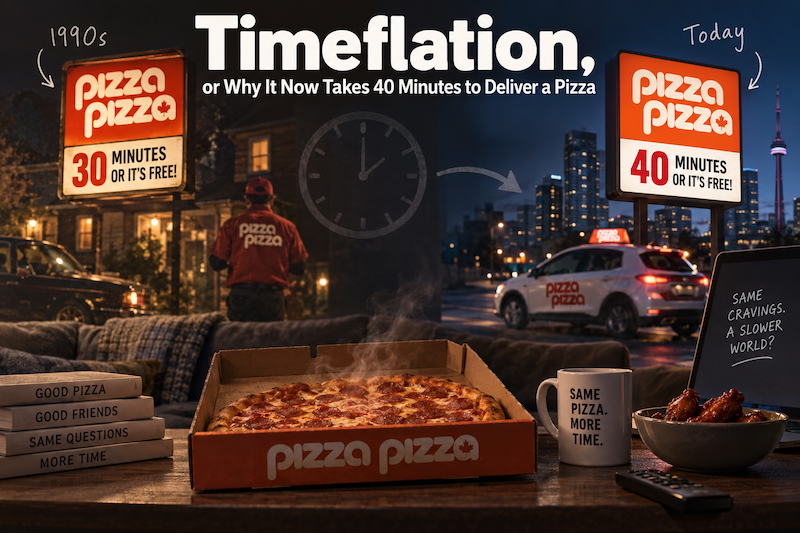
A friend was over last night for a late hang, and around 11pm he decided we needed pizza. My two local favourites are Martinos and Vitos, the latter of which happens to make some of the better wings in the city. My friend, being a very specific kind of stubborn Canadian, wanted Pizza Pizza. To each their own. So I ended up watching over his shoulder while he placed the order, and something on the delivery page stopped me for a second.
The guarantee had been quietly updated. I have a very specific memory of it reading 30 minutes or it's free from when my parents used to order pizza in the 1990s. That memory might be a bit muddled, since Domino's ran their own version of the same guarantee in the same era, and I may have merged the two in my head over the last thirty years. (Domino's, incidentally, dropped their promise in 1993 after a lawsuit related to a fatal accident involving a driver rushing to make the clock.) Whatever the original Pizza Pizza number actually was, the delivery page in front of me last night read 40 minutes or it's free.
The thing that struck me is this. In an era of GPS, optimal routing algorithms, kitchen automation, and better delivery logistics than any pizza chain in history has ever had access to, you would think we could deliver a pizza faster than we used to, not slower. That is not what the sign says. And once I started thinking about it, the sign is only a very small, very specific piece of a much broader phenomenon that I do not think has a good name yet.
We spend a lot of time talking about monetary inflation, and lately about shrinkflation, which is the practice of quietly reducing the size of a product while keeping the price the same. What we do not talk about much is time inflation, or if you want a punchier word for it, timeflation. Which is what it should be called when the amount of time we all quietly accept it will take to accomplish an ordinary task has crept upward while nobody was watching. Pizza Pizza just handed us a rare artifact of the phenomenon, because they had physically committed the old number to a sign, and eventually the sign had to be updated. Most examples of timeflation do not come with a sign.
Once you notice it, it is everywhere
Customer service used to promise something like "your call will be answered in two to five minutes." That was optimistic even in its own time, but the number was two to five minutes. Today the polite phrasing is "we are experiencing higher than expected call volume," which has been on the recorded intro at every large Canadian company I have called for at least a decade and by now qualifies as a permanent operational state rather than a temporary condition. Hold times of thirty to ninety minutes are the working reality for most consumer-facing enterprises.
The reasons for that are not accidental. Over the last fifteen years, essentially every major Canadian telco, bank, and utility has invested heavily in pushing customers toward digital self-service. Call centres have been dramatically downsized, a lot of the remaining staff has been offshored to reduce cost per contact, and the human agents who are left have been reserved for cases the digital channels cannot handle. Which is to say, the cases where the digital channels have already failed you at least once. The result is that the phone queue you finally reach is filled entirely with people who have already tried three other things, sorted by whichever of them has the lowest expected value to the company. Bell has been particularly aggressive about this, and if you have called them recently to actually change anything on your account, you know exactly the maze I am describing. Somewhere in that maze there is a spreadsheet showing the savings from every seat that used to be a human being answering a phone. Somewhere on the other end of the call is a customer waiting fifty-five minutes to be told the thing they wanted was on the website all along, if only they had looked in a slightly different menu.
Doctor appointments follow the same pattern on a longer timescale. Specialists in Ontario are commonly booking eight months to a year out for anything that is not an emergency. Getting into a family doctor requires either the discipline to call at 8:01am on the day the slots open or a family doctor who has essentially retired their practice from taking new work. Even the actual appointment itself has drifted. The fifteen-minute wait past your booked time that used to be an apology-worthy inconvenience is now standard operating procedure, and thirty to sixty minutes past your slot is common enough that a reasonable person budgets it into their travel time.
Restaurants are the smallest, most everyday version of the same thing. A Tuesday night at a casual sit-down chain used to mean walking in and being seated within a couple of minutes. Now, in the same casual chain, on the same weeknight, the answer at the door is often "forty-five minutes," and if you look past the hostess into the dining room, half the tables are visibly empty. That is what it looks like when a restaurant is staffed for two-thirds of its physical capacity because it cannot find, afford, or retain enough workers to fully open the floor.
The other direction is real too
Timeflation is not the whole story, and being honest about the counter-examples matters, because a lot of ordinary tasks have moved dramatically in the other direction over the last twenty-five years. Depositing a cheque used to take a physical trip to a branch and about ten minutes with a teller. Now the cheque hits my account in under a minute from a phone in my pocket. Paying a bill used to involve a paper envelope and a stamp. Now it is a tap. Finding directions to a place I had never driven to used to involve a paper map, a highlighter, and a fairly high tolerance for being yelled at by whoever was in the passenger seat. Now I get in the car and say "take me there" to a screen that argues with me if I try to override it.
Booking travel used to involve a travel agent, an office visit, and a follow-up phone call. Now it takes about six minutes on a laptop, and the price is often better. Looking up how to configure a piece of software used to involve a manual whose page numbers you had to memorize. Now it involves typing a question. Getting a photograph out of a camera used to take three days at a Blacks. Now it happens before you have put the phone back in your pocket.
Every one of those examples is an unambiguous win. Anyone romantic enough to want to go back to physical bank branches and paper maps has, in my professional opinion, forgotten what physical bank branches and paper maps were actually like.
So where did all the time go?
Here is the interesting question. If every one of those individual tasks got dramatically faster, and there are arguably more items on that list than on the timeflation list, then in theory we should all be spending our days floating in an ocean of newly-freed time. And we are not. Anyone reading this will tell you, without much prompting, that they are more time-poor than they used to be, not less.
There is a concept from economics called the Jevons paradox that I think has some explanatory power here. In its original form, William Stanley Jevons observed in 1865 that when steam engines got more efficient at burning coal, England did not use less coal. It used more coal, because coal-fired steam power was now cheap enough to justify entirely new applications that had been uneconomic at the old efficiency. The efficiency gains got spent immediately on doing more of the newly-cheap thing.
Something similar seems to happen with time inside organizations. When a specific task gets much faster (depositing a cheque, running a background check, booking a doctor's appointment, ordering a pizza), the organization does not just pocket the savings. It spends them. It adds a compliance step. Then an identity verification step. Then a personalization layer. Then a "we've tried to call you three times about your extended warranty" upsell. Then an eight-page terms-of-service acceptance flow. Then a mandatory customer satisfaction survey emailed to you three hours afterward, whether or not you asked to receive email from that vendor. The core task takes a fraction of a second where it used to take fifteen minutes. The full end-to-end experience gets re-engineered to consume roughly the same fifteen minutes it always did, and often a little more.
I do not think anyone specifically set out to do this. Nobody at Bell sat in a room in 2015 and said "our hold times have gotten better, we should add friction to soak up the gains." What happened is that at each individual step, some particular decision looked defensible in isolation. Verification protects against fraud. Compliance protects against regulators. Upsells drive revenue. Surveys generate data the marketing team uses. Each of those individually might cost a customer thirty seconds. Stack all of them on top of an underlying task that itself now takes under a second, and you have re-inflated the interaction to right about where it was before, or slightly past it.
The 40-minute pizza is a rare thing
The Pizza Pizza guarantee is a rare version of this that shows up in public view, because somebody had physically committed the old number to a sign in a way that made it impossible to hide when it stopped being credible. Somebody in a corporate office had to make an actual decision to update the wall. Somebody had to sit with the fact that the old promise no longer worked. Most organizations never have that moment, because they never had the sign to begin with. They just quietly let the reasonable-expectation number drift upward, one unmeasured minute at a time, and let their customers individually and separately renegotiate what "reasonable" means.
The next time you find yourself on hold for the second hour of a working day, remember that the bank on the other end of the line can deposit a cheque in seconds from a moving car. The technology, in almost every case, has done exactly what technology is supposed to do. What is expanding to fill the space it opened up is everything else.
Topics: