3d-printing
California's 3D Printing Bill Won't Stop Gun Violence, But It Will Create a New Class of Criminals
"My conclusion was that it wouldn't work, it couldn't work, and it would hurt the people it claims to protect."
Earlier this year I wrote about New York's attempt to mandate filtering software on 3D printers, a bill that would require every printer sold in the state to run a government-blessed algorithm that tries to detect and block firearm component designs. My conclusion was that it wouldn't work, it couldn't work, and it would hurt the people it claims to protect. California looked at that proposal and said "hold my beer."
Assembly Bill 2047 takes the New York concept and cranks it to eleven. Where New York floated compliance requirements that were merely burdensome, California has produced legislation that is actively hostile to consumers, open-source software, and basic manufacturing rights. The EFF has already raised the alarm, and rightly so, because this bill doesn't just regulate 3D printing. It lays the groundwork for a surveillance and censorship apparatus that would make any authoritarian blush.
So What Does A.B. 2047 Actually Do?
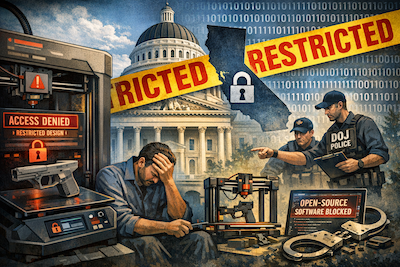
For those not familiar, here's the short version. A.B. 2047 requires every 3D printer sold in California to ship with a "state-certified print-blocking algorithm" that scans designs for firearm components and refuses to print them. Manufacturers must obtain Department of Justice certification before selling printers in-state. The DOJ would maintain a database of banned blueprints and publish a list of approved printer models. Printers would not be permitted to function with third-party or open-source firmware.
And here's the kicker: it would be a misdemeanour for any owner of a 3D printer to disable, deactivate, or otherwise circumvent the mandated algorithm. You read that correctly. Running open-source firmware on a printer you own would be a criminal offence. Selling a used printer that hasn't received the latest DOJ-approved software update could land you in legal trouble. California isn't regulating firearms here. It's regulating general-purpose manufacturing equipment and criminalizing the people who use it.
The Manufacturing Problem
Let's acknowledge the legitimate concern upfront. Gun violence is a real problem, and ghost guns (untraceable, home-manufactured firearms) are a genuine worry for law enforcement. Nobody serious disputes that. The question is whether slapping censorware on 3D printers does anything at all to address it.
It doesn't, and the reason is simple: at some point you're not banning 3D printing anymore. You're banning manufacturing. Human beings have been making firearms since the 10th century. A serviceable single-shot firearm can be built with hand tools and hardware store supplies. The Luty submachine gun was designed specifically to prove that point, using nothing but steel tubing and commonly available parts. No 3D printer required.
And I'd argue that shell casings are probably harder to manufacture than a fully working firearm. The equipment needed to manufacture working ammunition end-to-end (precision brass forming, primer compounds, consistent powder loads) is genuinely serious. Compared to that, the mechanical components of a simple firearm are almost trivially producible by anyone with access to a metal shop, a drill press, or even a decent file and some patience.
Chris Rock figured this out years ago. His bit about bullet control remains, against all odds, one of the more insightful policy analyses on the topic: make the ammunition expensive and suddenly the economics of gun violence change entirely. It's comedy, obviously, but it contains more practical logic than A.B. 2047 does.
The Squirt Gun Problem
What does a "state-certified algorithm" actually look like in practice? I walked through this in the New York piece, and the problem hasn't gotten any more solvable since then. A tube is a tube. A barrel-shaped object could be a firearm barrel, or it could be a pipe fitting, a telescope housing, a pen body, or a component for a Nerf-style blaster.
So I cannot 3D print a squirt gun? A cosplay prop? A Nerf-style dart launcher? At what point does a print "look scary" enough that the algorithm blocks it? The false positive problem is not a minor implementation detail. It is the entire problem. Any algorithm sensitive enough to catch actual firearm components will block enormous categories of legitimate prints. Any algorithm permissive enough to let those through will miss the things it's supposed to catch. This is not a matter of building a better algorithm. It is a fundamental limitation of the approach.
"State-Certified Algorithm" Has a Nice Ring to It
Let's dwell on that phrase for a moment: state-certified algorithm. The government certifies which software is permitted to run on your personal manufacturing equipment, and it is a criminal act to use anything else. If you wrote that into a dystopian novel, your editor would tell you to dial it back.
But wait, there's more. The bill effectively requires printers to phone home. Mandatory software updates mean mandatory network connections, which means mandatory data collection on what you're printing, when you're printing it, and whether you've been a good citizen and kept your firmware current. Combine this with the requirement that printers cannot function with third-party software, and you've handed manufacturers a government-mandated lock-in scheme that would make ink-cartridge printer companies weep with joy. Planned obsolescence becomes trivially easy when the government requires you to run only the manufacturer's software and the manufacturer can simply stop updating it.
I'm sure once this has passed, the wealthy residents of California can finally sleep at night knowing they are safe from roving gangs of armed Mangiones wielding 3D-printed zip guns. Meanwhile, every small manufacturer, educator, hobbyist, and prototyping shop in the state gets to navigate a DOJ certification bureaucracy just to do their jobs.
The Comparison
Compared to the Washington and New York laws proposed this year, California's is the most troubling. Washington's proposal was clumsy. New York's was impractical. California's is all of that plus genuinely dangerous. It criminalizes open-source software. It reduces consumer choice by design, not as a side effect. It creates a bureaucratic apparatus with built-in mission creep. And it establishes the precedent that the state can dictate what software runs on general-purpose equipment in your home or business.
The EFF makes the point that once this infrastructure exists, the scope will expand. Today it's firearm components. Tomorrow it's items that infringe on someone's copyright. Next year it's designs that someone in Sacramento decides are "dangerous" for reasons that haven't been invented yet. This isn't a slippery slope fallacy. This is a slippery slope blueprint, complete with legislative language that makes the expansion trivially easy.
The Bottom Line
The bottom line is that A.B. 2047 will not prevent a single determined person from manufacturing a firearm. What it will do is turn thousands of law-abiding Californians into criminals for running open-source software, hand manufacturers a government-enforced monopoly on printer ecosystems, and create a censorship infrastructure with no natural limiting principle. It is security theatre with teeth, and the teeth are pointed at the wrong people.
If California's legislators are serious about reducing gun violence, there are evidence-based approaches that actually work. This isn't one of them. This is the legislative equivalent of banning hammers because someone once used one as a weapon, then requiring every hammer sold in the state to include a government-certified algorithm that determines whether you're about to build a bookshelf or commit a crime. It would be funny if it weren't a real bill with real sponsors and a real chance of passing.
Topics: