microsoft
Thanks, Joan: Why My Email Address Has My Name in It Twice
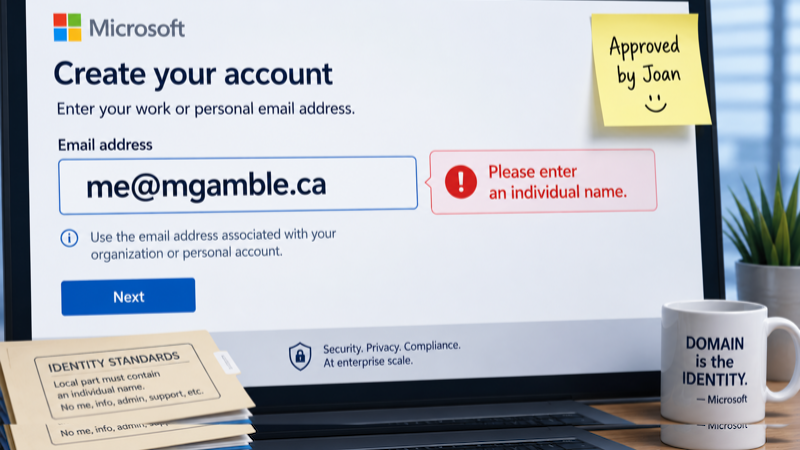
"Sorry this is so confusing. Even though me@ is your personal email address, it is too generic an email address for Microsoft to release SDK code to. Microsoft does require an individual name."
If you have ever sent me an email, you have probably noticed that my address is mgamble@mgamble.ca. The local part is my name. The domain is my name. Combined, they say my name twice. Most people are too polite to ask about it. The brave ones want to know whether it was an accident, a placeholder, or a mistake on the part of my registrar. It was none of those things. It is the result of one email exchange I had with Microsoft in 2007, and I have been living with the consequences ever since.
For those not familiar with the way an email address is constructed, the part before the @ is called the local part and the part after is called the domain. The convention most people follow is that the local part identifies the user and the domain identifies the host they belong to. mgamble@gmail.com is a person named mgamble at Gmail. But on a personally owned domain, where the entire reason I bought mgamble.ca in the first place was that the domain itself identifies me, the local part is essentially decorative. So my original personal email prior to November 2007 was me@mgamble.ca. I am me. The domain points at me. It made perfect sense to me.
It did not make perfect sense to Microsoft.
That year I was working on a client project that needed access to Microsoft's Windows Media licensing program. I sent the access request from me@mgamble.ca, and a few days later I got a reply from a rep named Joan:
Hello Matthew,
Sorry this is so confusing. Even though me@ is your personal email address, it is too generic an email address for Microsoft to release SDK code to. Microsoft does require an individual name.
Kindest regards,
Joan
Read that carefully. "Too generic." On a domain I owned outright, on which the domain itself was already my full name. Microsoft's identity system could not handle the possibility that the unique identifier was not the part of the address it expected it to be. In their model, the domain was infrastructure. The local part was the person. Somewhere in their internal process there was a check that flagged me, info, admin, and support as too generic to be a real human, and a real human had to clear that check before I could see SDK code.
No amount of explaining was going to move Joan, because Joan was downstream of the check, not in charge of it.
So I did what I had to do to get the project unstuck. I created a new alias on my own domain: mgamble@mgamble.ca. The most beautifully redundant email address you have ever seen. The local part says my name. The domain says my name. Combined they say my name twice. Joan was satisfied. The SDK was released. The project moved forward.
That was 2007. It is now 2026. I am still using mgamble@mgamble.ca, because changing your primary email address after nineteen years is the kind of project nobody undertakes voluntarily. Every time I type it into a signup form I think about Joan.
Here is the part that gets me
Microsoft has, in the intervening two decades, built one of the largest domain-as-identity businesses on the planet. Microsoft 365 organizes its entire enterprise customer base around tenant domains. Azure Active Directory, which is now Entra ID, treats your organization's domain as the central handle for every user, every group, every policy. Their entire modern identity stack is built on the premise that the domain is the identity. They sell that premise. They charge billions of dollars a year for it. Every IT administrator at every Microsoft customer in the world spends part of their week thinking in domain-first terms because Microsoft told them to.
And in 2007 the same company made me put my surname in front of my surname-dot-ca because somewhere in their licensing pipeline a process could not believe a domain might be an identity.
The bottom line
I am not really angry about it. I find it funny, and I find it a useful little reminder. The systems we ship encode the assumptions of the people who designed them. Those assumptions are usually invisible until they collide with a use case nobody on the design team imagined. Sometimes the cost is small, like a redundant email address you live with for nineteen years. Sometimes the cost is large, like the forms that still reject hyphenated last names, the password fields that strip your apostrophe, the payment systems that bounce your postal code because it has letters in it, the signup flows that won't accept a + in an email address even though it has been valid since 1982.
Every one of those errors has a user on the other side of it, staring at the screen, wondering who decided this.
So that is why my email is mgamble@mgamble.ca.
Thanks, Joan.