travel
The Long Way to Paris
"It was not a simple four-hour train ride from Köln to Paris."
This article has been updated since the original post yesterday with additonal commentary at the bottom
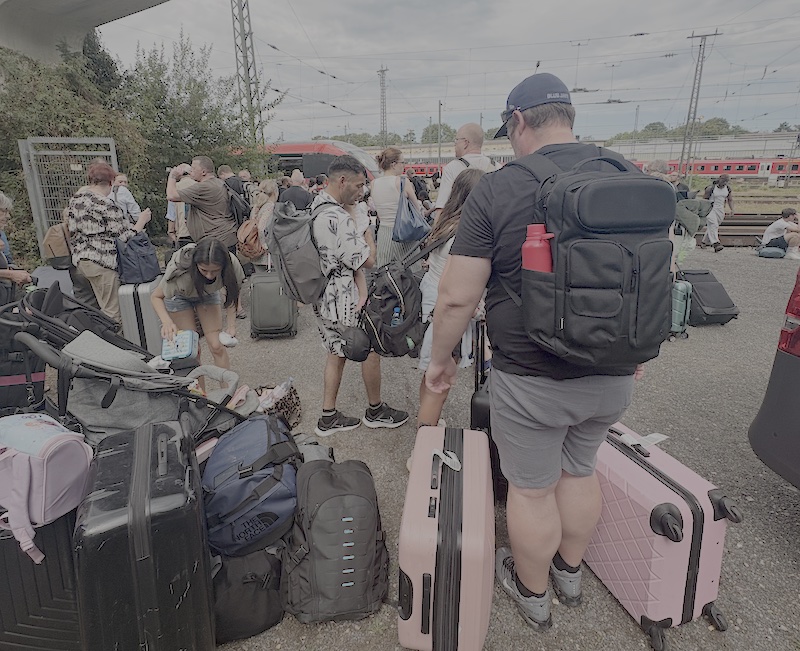
As some of you may have picked up from last week's ambiguous encounter with a possibly-crocodile-infested Amsterdam canal, my family and I are currently in Europe. After a few very good days in the Netherlands, we headed south to spend some time in Köln, and this morning we packed up, checked out of the hotel, and made our way to the Hauptbahnhof for what was billed on the boarding pass as a simple four-hour train ride from Köln to Paris.
It was not a simple four-hour train ride from Köln to Paris.
What follows is my running timeline, kept because I had a phone with battery, roughly no other way to pass the time, and the growing conviction that this was going to be a story I would want to write down. All times are local. All exasperation is my own.
The morning
09:25 or so. Train departs Köln about twenty minutes late. Nothing dramatic. European trains run late sometimes, it happens, the WiFi works, the seats are fine. We are only slightly behind schedule to arrive in Paris at 12:05 for a leisurely afternoon.
The car begins to warm up.
09:45. Somewhere just past Aachen, the train loses power. All of it. The lights go out. The AC goes silent. The little service screens that had been showing our next stop go black. There is that specific silence you get on a suddenly-dead train, which is the silence of about four hundred people all realizing at the same time that this is not a normal moment. Someone jokenly suggests the Germans didn't pay the electic bill.
Someone tries to open the door to get some fresh air and cannot. Someone across the aisle explains that opening the door on this class of train is, apparently, actually illegal in Germany for saftey reasons. Even now, stationary, in the middle of a field, this apparently still applies. The rules are the rules. Somebody in another row goes off in search of an actual German police officer or crew member to see if they can get permission to open a door for airflow. Nothing is happening quickly.
The car continues to warm up.
10:17. I receive the following text message from Deutsche Bahn.

Thank you, Deutsche Bahn. I am in fact on the train. I have been aware for a solid thirty-two minutes now that my train has stopped on the DB network. I appreciate the update. Truly.
10:35. Fifty minutes in, someone somewhere makes an executive decision, and somehow a door on our car finally opens. There is polite sigh of relief. The relief is more symbolic than practical, because a single open door at one end of a stationary train does not, it turns out, produce a meaningful cross-breeze.
10:42. Some minimal power comes back on. Not enough to run the AC, but enough to produce a faint low-frequency hum from somewhere in the ceiling, which everyone in my car chooses to interpret as progress even though it could equally be the sound of the train giving up. Somebody starts a rumour that we might be moving soon. We are not.
The pretending-this-is-fine phase
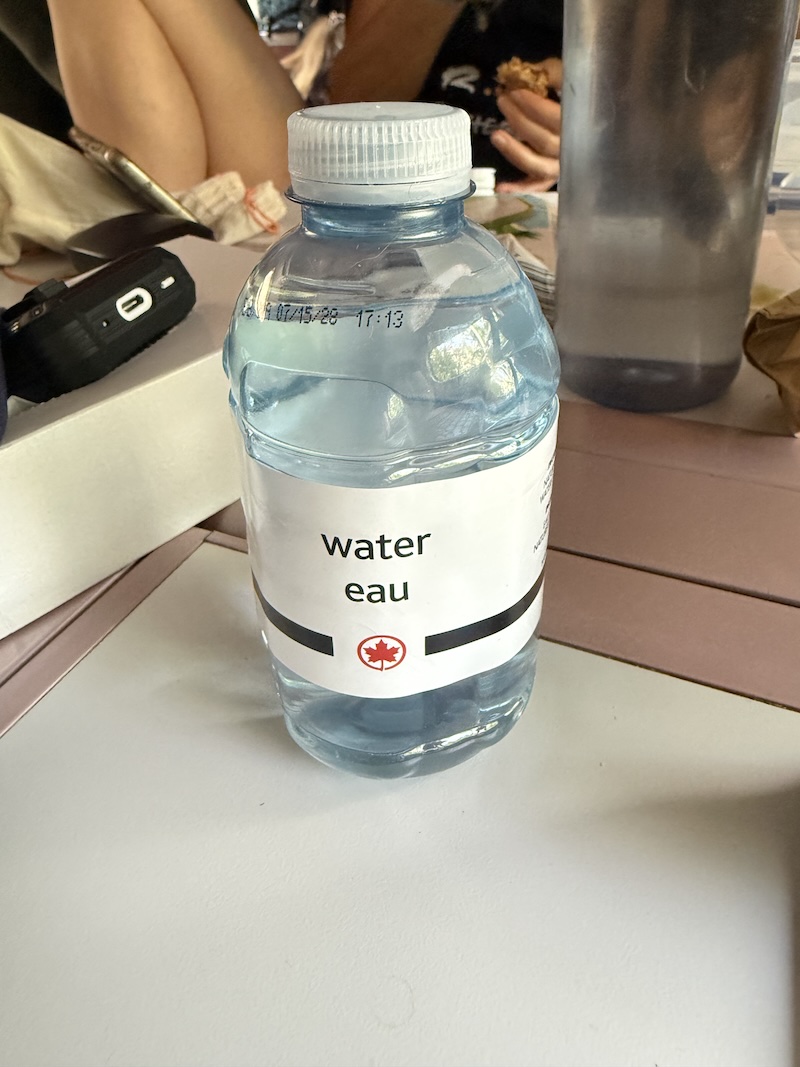
11:00. Genuinely hot now. The type of hot where things are just uncomfortable. Dry, hot, minimal airflow. It has to be at least 40 degress if not more. I'm running low on water, but thankfully my wife has a very small bottle left over from the plane. It is the best luke warm Air Canada water I've ever had.
I check the Eurostar site. It still shows our arrival time as 12:05. It also shows a status message, which reads, in full: "Due to traffic issues on the German network, your train has temporarily stopped. We're looking into the issue and will update you shortly on how it may affect your journey. Thanks for your patience."
The reason for the stop, communicated to a train full of people baking in one, is traffic issues. As though we are stuck behind a slow-moving lorry on the A2.
11:03. A PA announcement comes on. The German passengers across from me appear to communicate through eyebrow movements that this is a non-update. I look questioningly. They shake their heads gently. Nothing new. We continue to sweat. At least we are making friends.
11:22. Two workers in high-visibility vests, escorted by German police, walk past the side of the train.
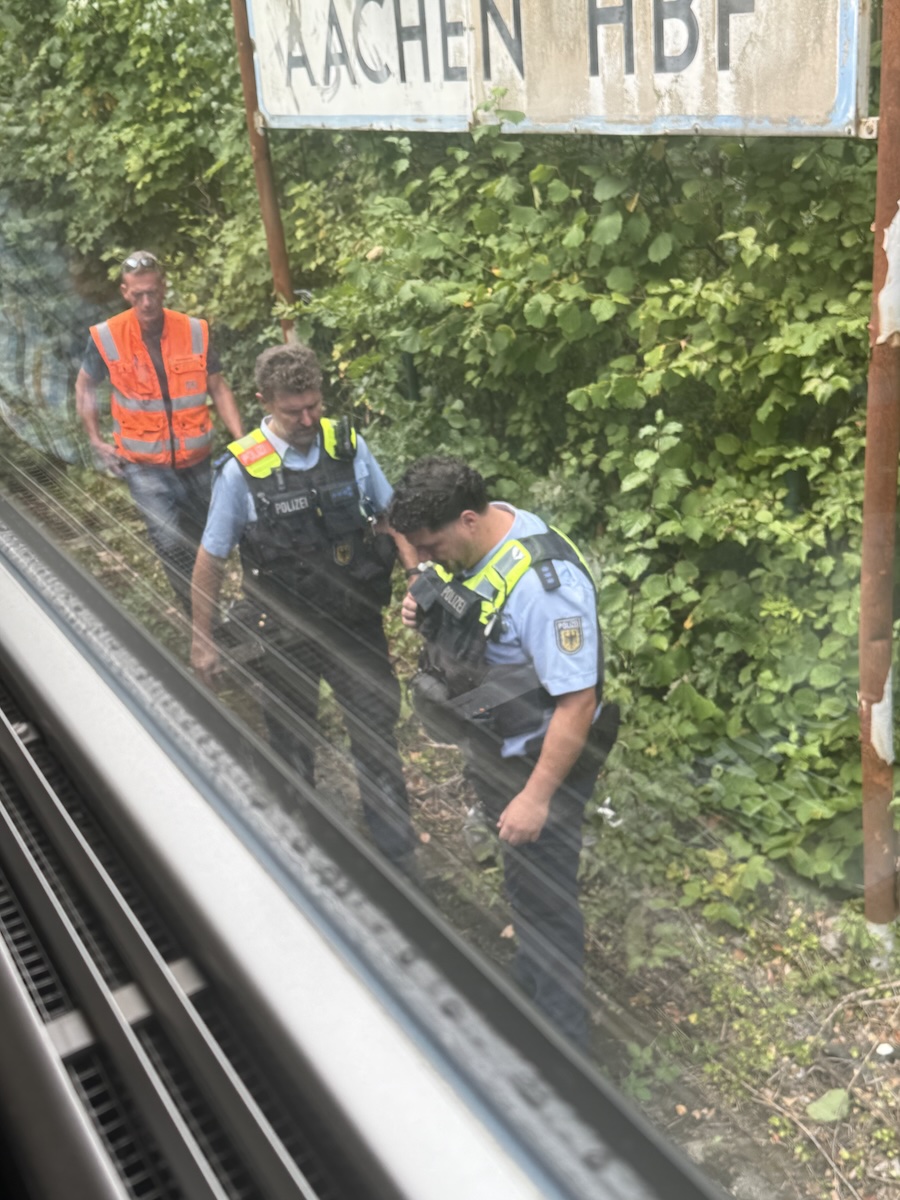
Something is definitely happening. What that something is remains a total mystery from inside a train car with no PA that we can hear over the sound of ambient wilting. My theory: they are here to ask us politely to close the door.
11:26. My wife makes an attempt on the bathroom. It is pitch black in there, as one would expect on a train with no power. She reports on return that the section of the train containing the bathroom is meaningfully cooler than where we are sitting, by which she means roughly five to seven degrees. So I guess we picked the worst seats in a no-power situation. The lights inside the car come on faintly at this exact moment, presumably to celebrate her return. Still no AC.
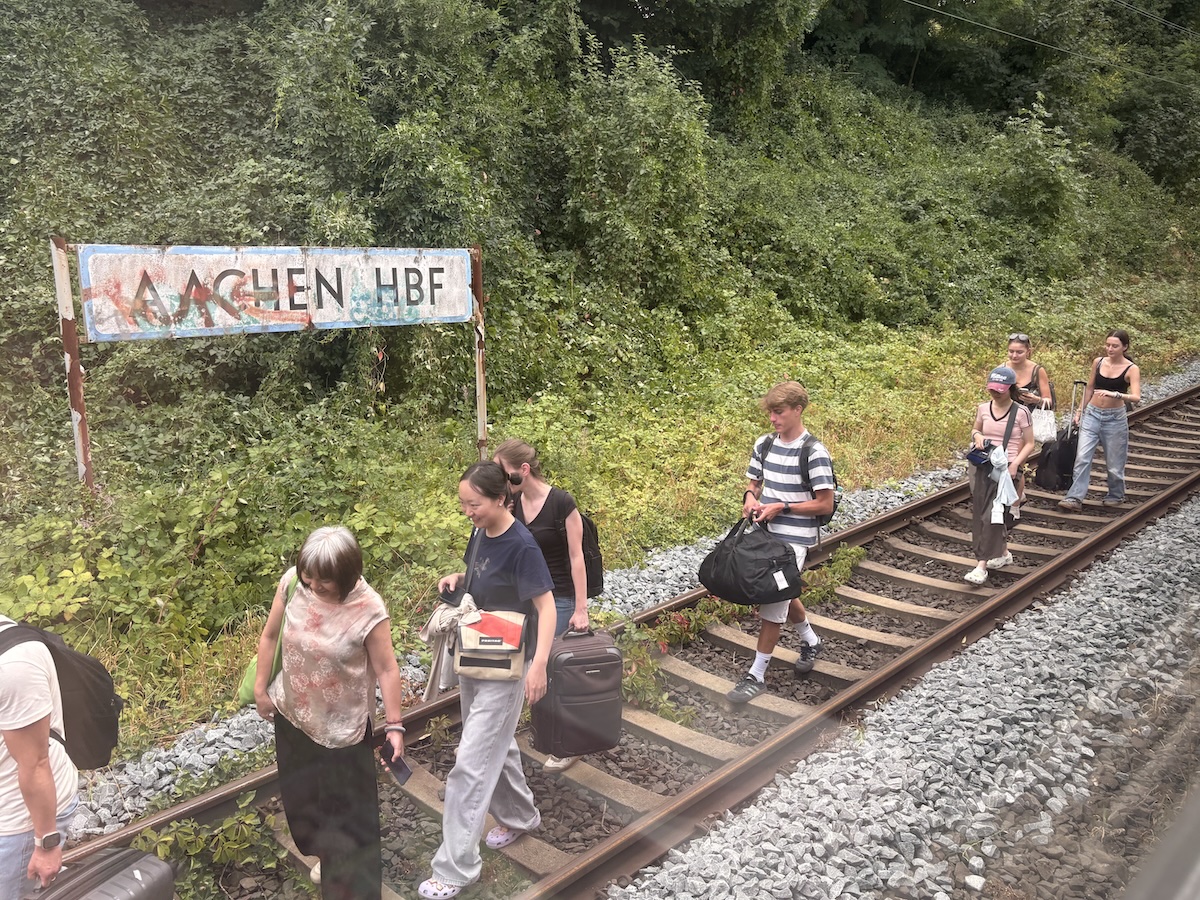
11:28. We glance out the window and observe some other passengers, several cars ahead, getting off the train with their luggage and walking back along the tracks toward what I assume is Aachen. Nobody in our car has said anything about disembarking. This feels like the kind of information that ought to be shared with all four hundred of us at roughly the same time. It's starting to look like some post-apocolypic movie outside with people walking down train tracks next to a out of service train carrying all their belongings.
11:32. The next Köln-to-Paris train, the one scheduled to leave two hours after ours, appears on the Eurostar app as cancelled. This makes sense. You do not send additional people down a water slide when it's already jammed, that's just common sense.
11:33. Whispered word makes it back that the entire train is being evacuated. Since we are in the last car, we will be the last to leave. My son, who has been magnificent about this whole affair, considers the situation for a moment and pronounces his verdict: "bastards." I do not disagree.
Google Maps informs me that the walk from our current location back to the Aachen station, dragging our checked bags along active train tracks, is roughly 700 hundred metres. Fun.
The bus phase
11:48. An email arrives from DB confirming that a replacement bus will take us to a different train station, roughly forty-five minutes away, where a replacement train will take us to Paris. This is the first useful information I have received from any part of the system this morning. It has been just over two hours since we stopped.
12:29. We arrive back at Aachen station. Luggage dragged. Legs sore. Nobody at the station has any specific instructions for us, but not everyone from our train is back yet, so we mill around in the general concept of a queue with several hundred other passengers, some of whom look like they have been having a worse morning than we have.
At some point during the milling, I begin quietly singing Lost Together by Blue Rodeo, which is a very Canadian coping mechanism. I say to my wife "Hey - if we're lost, at least we're lost together", right?
13:00. Between the last update and now some buses arrived and we have been waiting in various queues, but all the visible buses appear to be full. We are on none of them. There is a man from the train company who is investgiating thigs. I make the terrible pun that he is an in-vest-tgater. My family groans. This wasn't the time for #dadjokes.
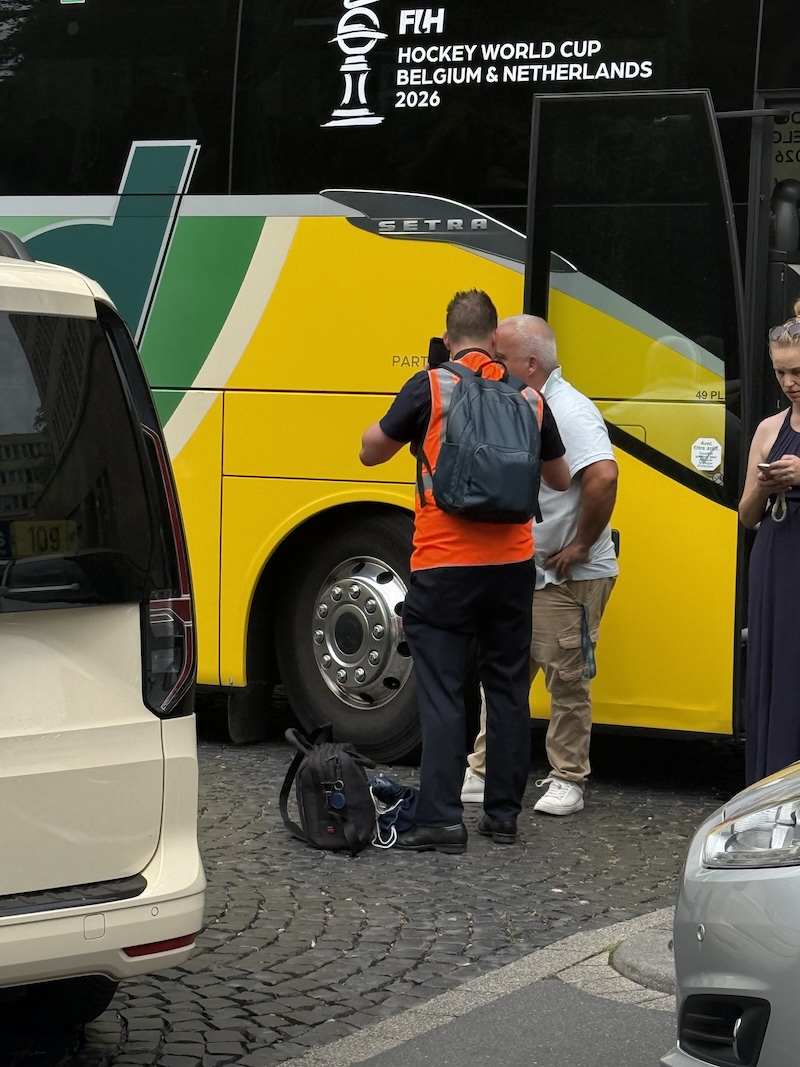
13:10. We are finally on a bus. There is a small logistical crisis unfolding at the door because some other passengers have been offered a direct bus to Paris somehow (I didn't get that email) rather than the routing through Belgium, so luggage is being loaded and unloaded from the same compartment at the same time by different people. Nobody is in charge. Everyone is in charge. This is Germany, so somehow it still eventually works.
13:25. A man boarding our bus has, as his checked luggage, a full-sized bicycle. He is asked to get off. I have some sympathy for the bus driver, whose luggage compartment is not built for bicycles, but the man had the bike in Köln when this whole trip started. The alternative here is what, exactly? He is very unhappy. So am I, on his behalf. He gets off the bus. I do not know how his day continued.
13:37. The bus departs Aachen for Liège-Guillemins station, in Belgium.
13:41. Four minutes into the bus ride, I check Find My on my phone, and it reports that one of our bags was last seen six minutes ago, still at the train station. My wife swears she watched it get loaded onto our bus. Find My updates. Now it says seven minutes ago. Now eight. I am doing that thing where you calmly explain to your family that it is probably fine while your internal monologue is entirely composed of the shrug emoticon.

The bag is presumably in a luggage compartment far enough from an active Apple device for the last-known location to be genuinely stale. This is the theory I go with. Everyone in the family pretends to accept it.
14:33. We arrive at Liège-Guillemins. DB has, credit where due, actually prepared two replacement trains here: one for today's marooned passengers, and one for the overflow from yesterday's cancelled service (I hear something about high winds and a landslide, though nobody I ask has quite the same story). Our bags (including my "forgotten" bag) roll calmly off the bus, as though it had never been anywhere else. Turns out a bus's luggage cage is a Faraday cage of sorts. While walking to the train I notice the man wearing a Toronto Blue Jays cap. He notices mine at almost the same moment. We do the small nod that two Torontonians do when they recognize each other stranded on the same accidental Belgian rail platform. Canada represent.
14:46. Seated on the replacement train, waiting for departure.
15:16. The new train is in motion to Paris. I'm writing this article and hope I don't have to write a part 2. I don't have a sequel in me today.
A brief note on this being a pattern
The last time I wrote a real-time travel-nightmare timeline was in March 2021, in Newark, when a snowstorm and an incompetent airline had me stranded at EWR for the better part of a day. At the twelve-hour mark, someone texted me "So… you live in Newark now?" At the time it felt like the joke of my life. It occurs to me now, five years later, on a replacement train in Belgium that has not yet moved, that the joke may in fact be that I keep doing this.
I am not a person who invites transit chaos. Transit chaos, apparently, invites me.
The train has just started moving. Ask me again in a few hours whether we made it.
Update - We made it!
We rolled into Paris Gare du Nord around 6pm local time. Six hours late, which given the shape of the day felt like a small miracle. The replacement train, once we finally got moving out of Liège, did the entire last leg at what appeared to be a real Eurostar cruising speed. If you have never had the pleasure, these trains hit somewhere north of 300 km/h on open track, and after a morning of hitting exactly zero km/h in a field near Aachen, watching the Belgian countryside flash past at three hundred kilometres per hour was, honestly, moving. I have never appreciated a moving train more.
What my kids taught me
For those who do not know them, my kids are young. Nine hours of transit chaos is a stress test for adults. It is a completely different order of stress test for children, who do not have decades of I have been through worse to fall back on and who genuinely do not understand why the grown-ups do not have a plan.
They were magnificent.
There was, of course, one hard moment. At Liège-Guillemins, both kids were hungry and tired and wanted food, and I was trying to balance running for something edible with staying close enough to hear whichever announcement was going to tell us which train to board. In the end I sprinted into a small station shop and grabbed whatever I could get my hands on quickly. Water, chips, and a few sandwiches. One of those sandwiches was salami. It might be the best salami sandwich I have ever eaten. It is entirely possible that in objective terms it was a completely ordinary station-shop salami sandwich, and that I was just so exhausted and adrenalized and hungry that any structured food product would have tasted like it came from a Michelin restaurant. I did not care. I inhaled it.
Other than that one crisis-of-carbohydrates, they held it together for the entire day. My eleven-year-old's "bastards" moment on the evacuation announcement was, in hindsight, the most emotionally expressive he got the whole time. He mostly just dragged his own bag and asked reasonable questions.
The thing I keep coming back to, the day after, is that the version of this trip where the kids panicked is a completely different trip. Watching them not panic made it dramatically easier for me and my wife not to panic. There is an operational lesson here that transfers directly into every professional environment I have ever worked in. In a crisis, panic is contagious. So is calm. You have significantly more control over which one spreads than you think.
The one thing Eurostar could fix
If I had one specific piece of feedback for Eurostar and DB after all this, it would be this. Communication is the entire game.
For nine hours, essentially every piece of useful information I received about our situation came from another passenger. The whisper that we were being evacuated. The theory about the landslide. The realization that other passengers had already left their cars and started walking. The much-later understanding that the emergency buses in Aachen appeared full because a scheduled Liège-Paris coach was loading from the same spot. All of it, word of mouth.
Somebody in a Eurostar or DB uniform, somewhere in this system, knew each of these facts long before I did. What I never had was a clean channel to that person. The text messages from DB were, without exception, useless. The status updates on the Eurostar app were, without exception, useless. The PA announcements on the train were mostly inaudible when they happened, and mostly non-updates when they were audible. Everything actionable came from the passenger sitting across from me, who heard it from the passenger sitting across from him, who heard it from someone who had walked past a station worker four cars ahead.
For those not familiar, there is a famous Simpsons gag from the 1995 episode "The PTA Disbands" in which a rumour about the teachers' strike is passed down a chain of children through a game of telephone. It starts as something coherent. By the time it reaches the last kid, it has become "purple monkey dishwasher." That is exactly what word-of-mouth communication looks like in a crowd of hundreds of stressed passengers speaking half a dozen languages. By the time anything reaches the last car on the train, it is purple monkey dishwasher.
I do not underestimate how hard the underlying problem is. Communicating clearly with hundreds of people in real time in multiple languages under stress, with an unfolding operational situation you may not fully understand yourself, is genuinely difficult. But the current system, which appears to be hope the passengers tell each other, is not solving that problem. It is producing purple monkey dishwasher and calling it customer service.
The Liège bus mess is the clearest example. If literally one person with a sign had stood in front of the coaches saying Aachen replacement here, Liège-Paris scheduled service over there, the whole thing would have moved in half the time. The fix does not require a mobile app or a new backend. It requires a person with a sign.
We got to Paris. The kids were great. The sandwich was, on further reflection, probably fine. Everything else was noise.
Topics: