ai
Are AI Models the New Firearms?
"I figured the policy world would take a few months to make my point for me."
Last week I argued that sovereign AI was the new space race and that Canada was bringing a sparkler to the launch pad. I figured the policy world would take a few months to make my point for me. It took eight days.
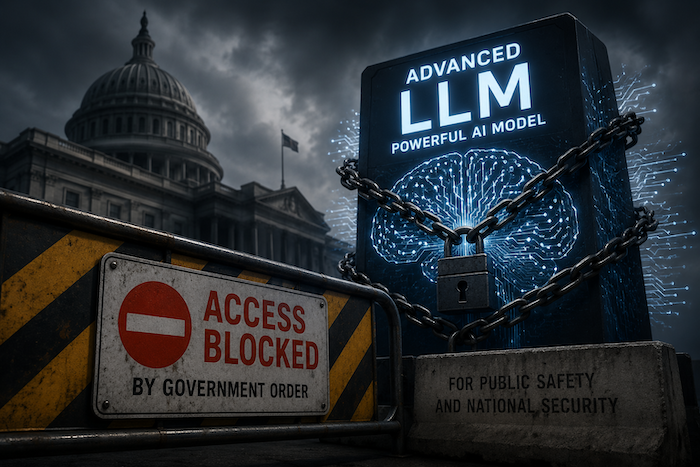
At 5:21pm Eastern on Thursday, the US government handed Anthropic an export control directive, citing national security authorities, ordering the company to suspend access to its two most capable models, Fable 5 and Mythos 5, for any foreign national, anywhere in the world, including foreign-national Anthropic employees. Anthropic, having no practical way to enforce citizenship checks at the model boundary in real time, pulled the models entirely. For everyone. Effective immediately.
If you are reading this from outside the United States, the strongest commercial AI model on the market was just declared off-limits to you by executive action, without a statute, without a hearing, and on the basis of what Anthropic itself describes as a narrow, non-universal jailbreak whose capability is "widely available from other models." Including, by Anthropic's specific citation, OpenAI's GPT-5.5.
This is a meaningful moment, and it is worth being clear-eyed about what just happened and what it tells us about what is coming.
The firearms parallel is no longer a metaphor
For those not familiar with how the US controls dual-use technology, "export controls" is the regime that historically applied to weapons, cryptography (in the old days), and certain classes of advanced computing hardware. The Bureau of Industry and Security publishes lists of what can and cannot be exported to whom, and the lists shift with administration. The directive on Fable 5 and Mythos 5 is the moment that regime was, for the first time, used to restrict access to a deployed commercial AI model the same way it has long been used to restrict access to firearms, missile guidance components, and high-end GPUs.
The firearms analogy in the title is not rhetorical anymore. It is structural.
In most non-US jurisdictions, getting a firearms licence is an administrative project. A six-month application process, a stated reason, secure storage requirements, documented chain of custody, periodic renewal, background checks against a national registry. The state decides which weapons each citizen is allowed to own, where, under what conditions, and reserves the right to revoke that permission for any number of reasons.
That is the trajectory frontier AI is now on. I would not be at all surprised, two years from today, to see a US regulatory regime that requires anyone running a high-capability model above some threshold to hold a federally issued licence, with an application process that documents what the model will be used for, where the weights will be stored, who will have query access, and what the audit trail looks like. The export-control posture is the on-ramp. Once a government has the precedent that it can take a frontier model off the market by executive action, the same authority can be used to gate it.
The corporate risk problem just got teeth
Here is the part that should be making CIOs and CTOs lose sleep, and it is the part that I think most of the commentary so far has missed.
If your business depends on a US-based frontier model as a load-bearing component of your stack, you have just learned, in public, that your model can be turned off by executive directive with no advance notice, no statutory process, and no realistic way to appeal in time. Anthropic's own statement is unusually candid on this point. They publicly disagree with the directive. They argue the basis is technically thin. They argue that applying this standard across the industry would "essentially halt all new model deployments for all frontier model providers." And they complied anyway. Because of course they did. They had to.
If you are running customer support, financial analysis, healthcare triage, legal review, code generation, or anything else that has gone load-bearing on a frontier API, you have a single-vendor risk that you may not have priced correctly. Your fallback is not "negotiate a price extension." Your fallback is "do you have a non-US frontier alternative ready to switch to in an afternoon?"
For Canadian customers, this is the moment Cohere becomes a strategic asset for the country. For European customers, Mistral becomes the same. DeepMind, which is technically a Google subsidiary but operates out of London, has a similar profile and an interestingly complicated relationship to US executive jurisdiction. The Anthropic directive does not yet tell us how that jurisdictional question will get resolved when the next directive arrives, and there will be a next directive.
The Blue Tory take is straightforward. A market with one vendor and zero substitute options is not a market. It is a hostage situation waiting to happen. Diversifying away from US-only AI infrastructure was a smart hedge eight days ago. It is now an operational requirement for anyone whose business does not survive a sudden Anthropic or OpenAI outage triggered by a policy decision in Washington.
What Anthropic actually said is interesting
I want to be careful here. The temptation, if you sell AI safety positioning for a living, is to read this story as Anthropic getting caught in the crossfire of its own marketing. That framing is too easy.
Read the actual statement. Anthropic has done something pretty unusual for a US company on the receiving end of a national security directive. They published the chain of events publicly within hours. They disagreed with the legal basis in print. They described the underlying jailbreak as narrow and the capability as widely available. They noted that the standard, if applied broadly, would freeze the entire industry. They cited a competitor's published documentation to make the point. And they explicitly said the directive does not adhere to the principles of transparency, fairness, and technical fact that Anthropic itself has publicly endorsed as the right framework for government intervention in AI deployment.
This is closer to a polite filing of grievances than to a complaint, but in the current environment it is more pushback than most large vendors offer when an executive branch directive shows up at 5:21 on a Thursday. It deserves to be acknowledged on its own terms.
There is, however, an irony in the picture that I cannot ignore, and I do not think Anthropic can either. The argument that frontier AI is dangerous enough to require state-level oversight has been part of the safety-forward narrative the company has helped build for years. That narrative is a useful tool for a government that wants to claim jurisdiction. It is hard to spend half a decade arguing that frontier model capabilities require careful state stewardship and then be surprised when the state shows up to steward them. The Anthropic statement makes the right technical points about why this particular intervention is unwarranted. The deeper point, which I do not see them engaging with publicly, is whether the broader narrative gives every future intervention a much shorter ramp than it should have.
The perverse incentive nobody is talking about
There is a sharp game-theoretic problem buried in this. Every frontier lab outside the US is now watching what just happened to Anthropic and asking themselves whether the safest commercial posture going forward is to understate the capabilities of their next release.
Think about that for a second. If frontier capability is now the trigger that draws an export-control directive, the incentive for every other lab is to ship models that benchmark just below whatever threshold the government cares about, so they can keep their full customer base. Cohere has every reason to claim its next model is "less capable than Fable 5." So does Mistral. So does every Chinese lab that has been releasing weights openly until this point.
Two things follow. First, US-based development effectively stalls, because the next-generation US models are now the only ones in the world that can be shut down by an executive order, which means the next-generation US models are the ones with the highest deployment risk. Second, the public benchmarks become less reliable, because labs have a reason to misrepresent capability in either direction depending on which side of the threshold they want to be on.
If you wanted to design a policy lever that would freeze the US frontier in place while accelerating its competitors, this would be a reasonable first draft. I do not believe the directive was designed for that effect. I do believe it will have it.
A cynical follow-up question that some commenters have raised is worth airing. If the US frontier labs have privately concluded that progress is plateauing and that the next release would not deliver the capability gains the market expects, an export-control regime that pauses public deployments is a convenient way to delay the day the market notices. I am not saying that is what is happening. I am saying it is the kind of question reasonable people are going to start asking, and the directive makes the answer harder to come by.
The bigger pattern: medieval structure, hypermodern technology
But wait, there is more. The Fable 5 directive is not arriving in isolation. It lands in a wider moment in which the set of things you need to identify yourself to a government to access is steadily expanding.
The GUARD Act is currently moving in the Senate and would require government ID for AI use in certain categories. Several US states already require government ID to access adult content online. The UK's Online Safety Act introduces age verification for a broadening set of services. There is open discussion in Congress about ID checks for social media. The FCC, separately, is exploring rule changes that would effectively kill prepaid burner phones by requiring KYC at activation. Chamath Palihapitiya, on the All-In podcast, has openly called for ID verification before access to high-capability AI models.
None of these policies, taken individually, looks like the end of liberal modernity. Taken together they describe a world in which the digital commons is being slowly partitioned by identity status. Different people get different versions of the network. Different services are gated by different categories of citizenship, age, and verified identity. Frank Herbert's Dune universe was famously medieval in social structure (overlapping fiefs, controlled access, identity-bound privilege) while being thousands of years ahead of us technologically. We are heading, on a much shorter timescale, toward a digital version of the same. Hypermodern technology layered on top of a deeply pre-modern theory of who is allowed to access what.
The Fable 5 directive is one node in that picture, but it is the loudest one yet. It establishes the precedent that the US executive branch can restrict access to a deployed AI model on a categorical basis (citizenship), without legislative process, on a same-day timeline. Once that precedent exists, the only question is what category gets restricted next, and that has rarely been a hard question to answer when looking at history.
The bottom line
The bottom line is this. Eight days after I argued that sovereign AI was about to get hot, the US government showed everyone what sovereign AI restriction looks like in practice. They did it through Anthropic's most capable models, on the basis of a narrow technical concern that Anthropic itself describes as unjustified, with no statutory process, on a single Thursday afternoon. Anthropic complied, publicly disagreed, and tried to explain why the directive sets a standard that, if applied evenly, would freeze the industry.
The lesson for Canadian and European policymakers is the same one I tried to make last week. You cannot outsource your AI infrastructure to a foreign jurisdiction and expect to keep using it on your terms. Cohere and Mistral are not optional anymore. They are critical infrastructure for any economy that does not want its frontier capabilities held hostage to a directive arriving at 5:21 on someone else's Thursday.
The lesson for everyone else is that the firearms analogy is no longer a thought experiment. The US has established that it can take a frontier model off the market by executive action. The licensing regime, the categorical access gates, the ID-check infrastructure, and the rest of the machinery follow naturally from there. They will not all arrive next week, but the direction of travel is now visible enough that "I told you so" feels less like prediction and more like reading the schedule.
Watch this space. There will be a next directive. The question is who it lands on and how the rest of us are positioned when it does.
Topics: