Hard Conversations
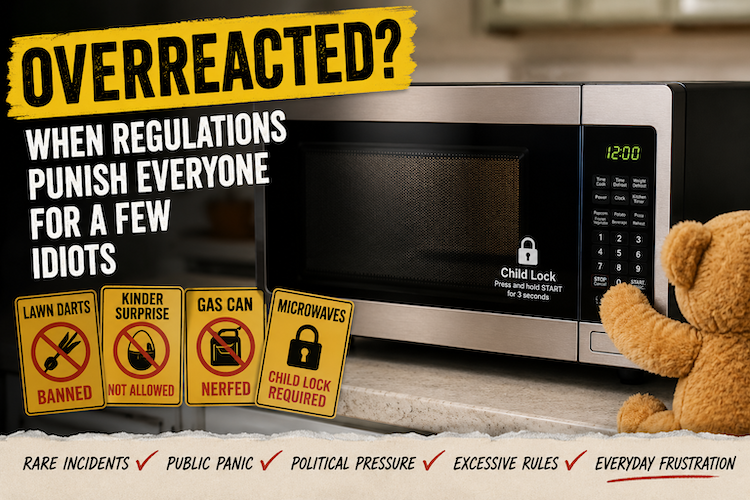
Won't Someone Please Think of the Children, Microwave Edition
"I was visiting a friend recently who had just bought a new microwave."
I was visiting a friend recently who had just bought a new microwave. I went to open it to reheat a coffee, and I could not. I pulled the handle. Nothing. I pulled harder, in case the thing was just stiff. Still nothing. I stood there in his kitchen for a solid two minutes looking like a man who has never operated a household appliance, until he wandered over and explained that the microwave had a mandatory child lock, and that opening it required a small secret handshake I had not been initiated into.
Naturally, this sent me down a rabbit hole. Why is this a thing? What problem are we actually solving here? Who decided that the simple act of opening a microwave door needed to become a two-step authentication process?
The standard behind the door
For those not familiar with how appliances get designed, manufacturers do not generally add friction to their own products for fun. They do it because a standard tells them to. In this case the culprit is UL 923, the Standard for Safety for Microwave Cooking Appliances, which now includes a child-resistant door requirement.
The genesis, according to UL Standards & Engagement, is this: between 2002 and 2012, more than 7,000 children under the age of five were treated for microwave-related burns in the United States.
I want to be careful here, because this is exactly the kind of statistic that gets people to stop thinking. A small child with a thermal burn is a genuine tragedy. If you have ever seen one, you do not forget it, and nobody reasonable wants more of them. The concern that motivated this requirement is real, and I am not going to pretend otherwise.
But there is more to that number than the headline. Seven thousand children sounds enormous until you notice the words "from 2002 to 2012." That is a ten-year span. It works out to roughly 700 children per year, in a country of more than 300 million people, with no accompanying detail on how serious the injuries were. A burn that needs a tube of ointment and a burn that needs a skin graft both count as "treated." We are reshaping the way every microwave in North America opens on the basis of a number that, once you do the division, is vanishingly small and almost entirely uncharacterized.
What the rule actually requires
Here is the requirement in its full, magnificent glory. The user must complete two distinct operations to open a door that allows access to the oven space. Sliding and pulling. Twisting and pushing. Touching two different touch pads, but not the same touch pad twice. That last one is my favourite, because someone clearly sat in a meeting and litigated whether double-tapping the same pad counted as one operation or two.
This is what the regulatory response to 700 burns a year looks like. Not a public education campaign. Not better warning labels. Not a cheap, optional latch for the small number of households that actually have a curious toddler and want one. A mandatory redesign of the core interaction of an appliance that sits in roughly every kitchen on the continent.
Designed for the least careful user
We have been here before, more than once. A few years back we had the Tide Pod challenge, in which a number of teenagers filmed themselves biting into laundry detergent packets because the internet had dared them to. The response from regulators and the industry was swift and predictable: opaque packaging, less transparent containers, tougher child-resistant lids, stronger warning labels, the full kit. Critics pointed out at the time that the media panic had badly exaggerated the scale of the thing relative to the total number of household-product exposure incidents, and they had a point.
But set the numbers aside for a second and just look at who was actually doing the challenge. Teenagers and young adults. Not toddlers. None of the new packaging, none of the redesigned lids, would stop a seventeen-year-old who has decided, on camera, to eat a detergent pod for clout. The new rules did precisely nothing to the people causing the problem. They added cost and inconvenience for the tens of millions of households who were never going to eat detergent in the first place. And that is the pattern, the one you cannot unsee once you have noticed it. Modern consumer products are increasingly designed around the least careful possible user. Not the average user, not even a below-average one, but the single most reckless person who could conceivably encounter the product, on their worst day, with a phone pointed at their face.
Or go back further, to lawn darts. For those too young to remember, Jarts were weighted metal spikes you lobbed underhand toward a plastic ring on the lawn, and they were glorious. After a small number of child deaths and serious injuries in the 1970s and 80s, the United States effectively banned them outright. I understand why. The injuries that did occur were catastrophic, often head injuries, and children were frequently the victims. But millions of sets were sold and used without anyone getting hurt, the injuries that happened almost always involved obvious misuse like kids hurling the darts at each other, and the danger was about as visually obvious as danger gets. It is a heavy metal spike. You throw it. The failure mode is not exactly hidden. We responded to the misuse of an obviously dangerous object by taking it away from everyone, careful and careless alike.
The same instinct has crept into washing machines, which now lock shut the moment they start. My parents had a top-loader from the 1970s, and as a kid I would occasionally pop it open mid-cycle to toss in a sock I had missed. I was never once tempted to stick my arm into the spinning drum, because I was a child, not a hamster. Most kids can read basic words by five or six, and all of them are sharp enough to watch what their parents do and copy it. The idea that a lock on the door is the only thing standing between a curious child and disaster gives both children and parents very little credit.
This was never really about a microwave
Here is where I have to admit the microwave is not actually what is bothering me. The microwave is a symptom. The disease is a quiet shift in what we have all agreed the default should be.
We are moving, steadily and without much debate, toward a world where the default setting on everything is to protect the user from themselves. Sometimes that is a physical latch. Increasingly, in my world, it is software.
Take System Integrity Protection in macOS. For those not familiar, SIP is a feature Apple introduced that walls off certain parts of the operating system so that not even the administrator, the actual human who owns the machine, can modify them. The intent is good. It stops a whole class of malware and prevents people from accidentally hosing their own system. As a security feature, it genuinely works.
But sit with the implication for a second. Apple created a privilege level on my computer that I, the owner, do not have access to by default. That is a remarkable thing to just accept. Yes, I know you can disable it. You reboot into recovery mode, run a command, reboot again, and you are free. But think about what that ceremony is telling you. To remove a stray attribute from a file I dragged to the wrong place, I am expected to reboot my computer into a special recovery environment, as though I were performing surgery. What if I never meant to drag the file at all? What if my hand just slipped off the trackpad? The machine's answer is that I should have been more careful, and that the cost of my carelessness is a multi-step recovery ritual.
I am as pro-security as anyone who has spent a career in this industry. But it is my computer. The defaults have quietly inverted, and we let them.
So what can we do about this?
So what can we do about this? The fix is almost embarrassingly simple, and it applies to the microwave and the macOS install in exactly the same way.
Make the default off.
If a family with a curious toddler wants their microwave door to require a secret handshake, fantastic, let them flip a setting and turn it on. The protection is there for the people who want it. If a user wants their operating system to lock them out of its own internals, let them opt in. But the starting position, the out-of-the-box state, should assume a competent adult until told otherwise. Opt-in protection respects the person. Opt-out protection assumes they are a hazard to themselves and makes them prove otherwise.
To be clear, I am not anti-regulation. Some rules save lives and I am glad we have them. Seatbelts, electrical codes, food safety, all worth it. There is a real line between protecting people from genuine, common, severe harm and protecting them from the one-in-a-million chance that they are an idiot. The child lock on a microwave is well over that line, and it is dragging a lot of other defaults across with it.
The bottom line
The bottom line is this. Every one of these features is defensible in isolation. A locked microwave, a child-proofed detergent pod, a banned lawn dart, a sealed washer, a walled-off operating system. Each one solves some real, if rare, problem. But added up, they describe a world that has quietly decided you cannot be trusted with the basic operation of your own things, and that the burden is now on you to opt out of being treated like a toddler.
I would just like to open the microwave. With one hand. On the first try. Is that really so much to ask?
Topics: